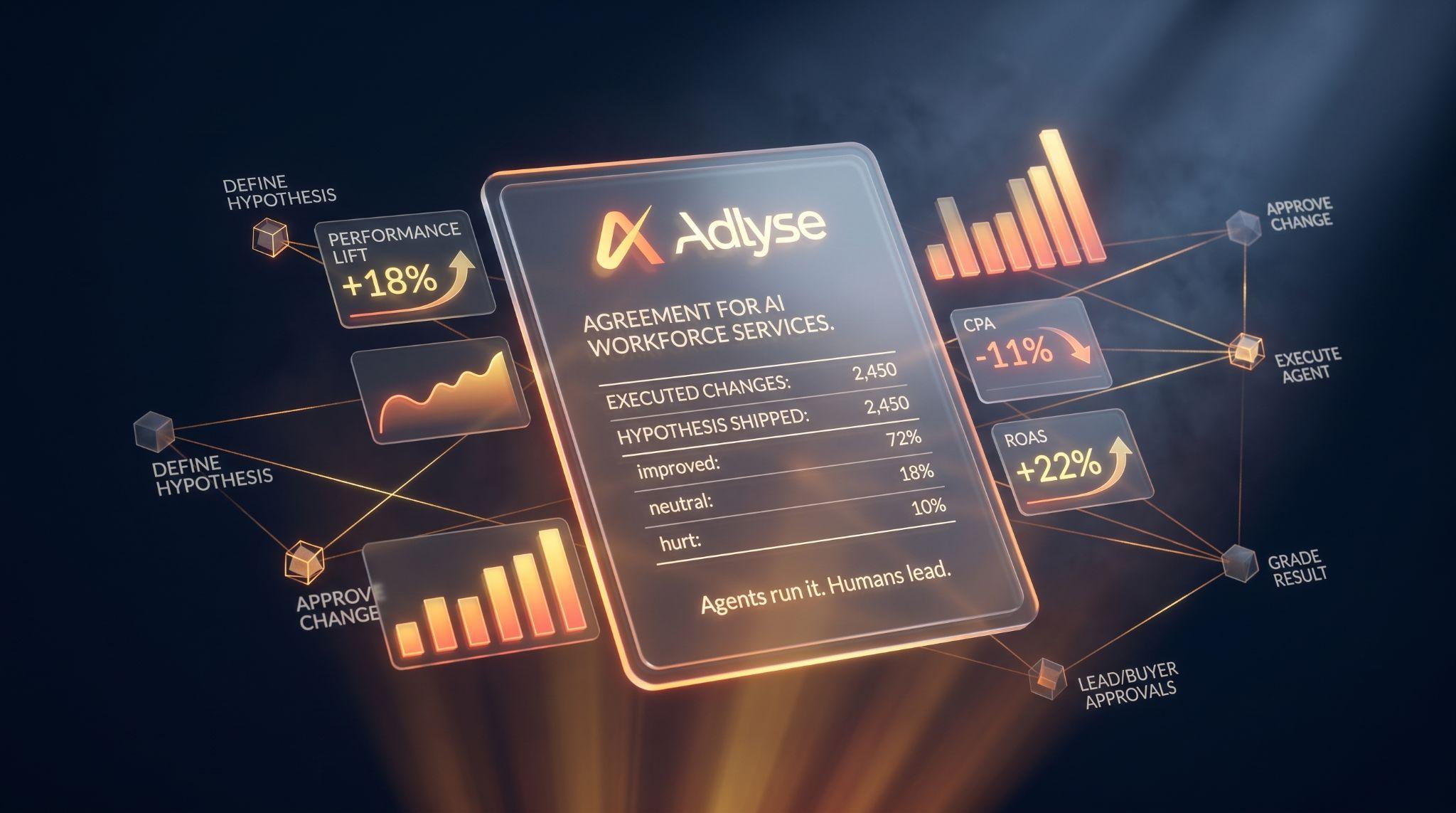

When AI agents take over execution, agencies priced on hours face a squeeze: the honest hour count drops while the value delivered rises. The way out is repricing from inputs to outcomes, retainers anchored to scope, judgment, and results rather than activity. Agencies that reprice early set the terms; agencies that keep billing phantom hours get repriced by their clients, or by an AI-native competitor's pitch deck.
The uncomfortable math arrives on its own schedule: the first time a client asks "if the agents do the work, what am I paying you for?", the answer is either already in your pricing model or it's a discount.
The problem: the retainer built on hours that no longer exist
A typical mid-size agency retainer is a quiet hours model even when it's called something else: the fee roughly reflects the account team time a client consumes, and execution, the changing of bids, budgets, structures, and creative, is most of that time. Agentic execution collapses that line. The changes still happen (more of them, faster), but the hours behind them shrink to approval and direction time. That same shrinkage is what lets teams scale paid media without hiring; here it shows up as a pricing problem instead of a capacity one.
Three bad responses appear immediately. Keep billing as if the hours were still there, and you're one procurement audit away from a trust problem. Pass the savings straight through as a discount, and you've priced your own margin out of existence while doing better work. Hide the agents entirely, and you've made transparency, your best story, into a liability. The repricing conversation is coming either way; the only question is who leads it. The margin mechanics driving it, fewer manual hours per account for the same output, are covered in how small agencies increase their margins with AI.
What are clients actually paying for now?
Strip out execution hours and what remains is, inconveniently for hourly billing, the valuable part: judgment (which changes to approve, which tests to run, when to trust the machine and when to constrain it), direction (objectives, guardrails, strategy per client), accountability (a named human answers for every change, with the audit trail to prove it), and results. None of these scale with hours. All of them scale with the quality of the people and the intelligence accumulated on the account.
That last item deserves emphasis in pricing: on an agentic platform, every month of approvals and outcomes compounds into per-account intelligence. A client's account at month twelve is operationally smarter than at month one, a genuinely increasing asset that hourly pricing values at exactly zero. Outcome-anchored pricing lets you charge for it.
The three repricing models (and who each fits)
Model 1, Scope-based flat retainer
Price the job to be done: platforms covered, spend managed, testing cadence, reporting depth, meeting rhythm. Hours never appear. This is the least disruptive migration from a classic retainer, most clients experience it as "same fee, clearer promise", and it quietly stops the phantom-hours problem. Fits: the majority of the book, especially clients who value stability.
Model 2, Base + performance component
A leaner scope fee plus a bonus tied to agreed outcomes: efficiency against target, growth milestones, incrementality-verified results. Powerful alignment, with two honest warnings, the metric must be one you can defend (platform-reported ROAS alone invites disputes; blended or incrementality-verified measures survive scrutiny), and you're taking on variance that the flat model doesn't have. Fits: confident relationships with clean measurement.
Model 3, Spend-percentage with a floor
The old media-commission model, modernized with a minimum. It scales with client growth and is simple to administer, but it inherits the classic critique, your revenue rises when spend rises, whether or not spend should rise, which sits awkwardly next to an efficiency story. Fits: high-growth clients where scaling spend genuinely is the mandate.
Most agencies land on Model 1 for the book and Model 2 for their most mature relationships. Whatever the model: the fee should never again be explainable as an hour count, because your hours are no longer where your value lives.
The three conversations you're going to have
"The AI does the work now, shouldn't this cost less?"
Reframe from cost of effort to value of outcome: the client is getting more changes, faster reactions, continuous coverage, and a full audit trail, a better product than the manual version. Concede the true point (execution hours fell) while holding the real one (judgment, accountability, and results didn't get cheaper; they got more valuable). If the retainer was honestly scoped, "same fee, more delivered" is a defensible and often generous position.
The AI-native competitor pitching half your fee
Don't compete on the fee; compete on what the fee buys. A cheap pitch built on unsupervised automation has no answer for governance: who approves changes, what the audit trail shows, what happens when the agent is confidently wrong. Your counter is the supervised model, agents run it, your named people lead it, plus the per-account intelligence a switch would forfeit. Some price-only clients will leave; they were leaving eventually.
The renewal where you introduce the new model
Lead with the upgraded deliverable, not the pricing mechanics: here's what the agentic operating model added to your account this year, reaction speed, change volume, the trail, the results. Then present the new structure as the honest way to price that. Grandfather generously where relationships warrant it; the goal is a book repriced over four quarters, not a standoff this quarter.
What to do this quarter
Audit where retainer hours actually go today, most agencies are estimating, and the repricing case starts with the real number. Pick the model per client tier rather than one-size-fits-all. Rewrite your scope language so deliverables are outcomes and coverage, never hours. And rehearse the "what am I paying you for" answer with the team before a client asks it, the worst version of this conversation is the improvised one. For the operational side of running many clients on agents, see what changes for multi-client campaign management.
FAQ
Should agencies charge less because AI reduced the work?
Charge differently, not necessarily less. The hours fell; the deliverable improved. Agencies that reprice to scope and outcomes usually maintain or grow fees while being more honest than the hourly model ever was. Racing your own price down concedes a value story you actually own.
How do we explain agent use to procurement?
With the audit trail. Procurement's real question is control and accountability, and a supervised agentic model answers it better than manual operations: every change logged with signal, reasoning, named approver, and outcome. Lead with that record, it turns the AI disclosure from a discount trigger into a diligence advantage.
What happens to junior staff economics?
The leverage-pyramid model (bill juniors doing execution at a markup) erodes. The replacement is a judgment pyramid: juniors learn by reviewing agent reasoning in the approval queue, and the agency's margin comes from senior judgment spread across more accounts rather than junior hours multiplied.
Which metric should a performance bonus use?
One you can defend in a dispute: blended efficiency (MER-style), agreed north-star outcomes, or incrementality-verified lift. Avoid single-platform attributed ROAS as a bonus basis, it moves when attribution settings move, and both sides eventually know it.
When is the right time to reprice?
Before the client forces it. The natural moments are renewal, a scope change, or the rollout of agentic operations itself, "we're upgrading how your account runs, and here's the pricing that matches it" is a far stronger frame than a defensive mid-contract renegotiation.
Want the operating model that makes the repricing story true, agents executing, your team leading, everything logged? Start with a free audit.
Start a free audit