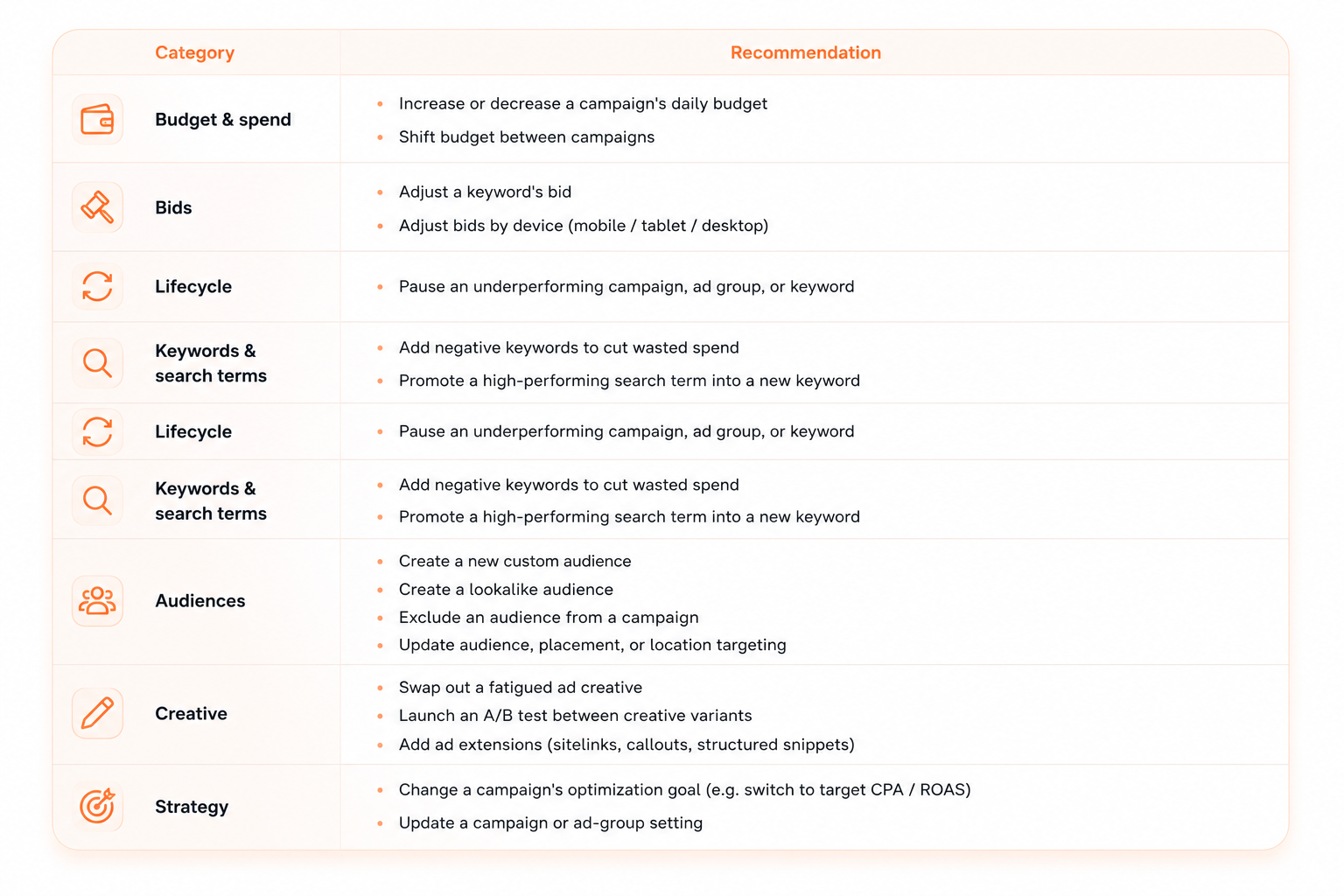

An agentic workforce is a performance team where AI agents hold the operational jobs, pacing, hygiene, rotation, reallocation, and humans hold the leadership jobs: objectives, approvals, tests, and accountability. The unit of headcount planning changes from "people who make changes" to "people who direct and approve a portfolio of agents." The structure isn't fewer humans doing the same work; it's the same humans doing different work, across far more surface.
The org chart is the last place most teams look when adopting AI agents. It should be the first, because an agent without a defined job, a manager, and a review process is exactly as useful as a human hire without them.
The problem: the team that was always behind
Picture a typical setup at a DTC brand spending $180K/month: two performance marketers and a lead. Between them they run Meta, Google, and a TikTok test, plus email handoffs, promo calendars, and reporting. Their week is triage. Search-term reviews happen "when there's time," which means monthly. Creative fatigue gets noticed after CPA damage, not before. The TikTok test has had the same three ads since April because nobody's had a free afternoon. Budget splits between platforms were set in Q1 and defended by inertia ever since.
Nobody on this team is bad at their job. The job is simply bigger than the team, and it grows every time a platform ships a new surface, format, or default. Hiring a third marketer buys about eighteen months before the same wall returns. That's the problem the agentic workforce actually solves: not replacing the three humans, but ending the arithmetic where operational surface always outruns human attention.
The org chart: who holds which job
In an agentic operating model, work divides by its nature, not by seniority.
Agents hold the jobs that are continuous, high-frequency, and signal-driven. Think of them as a portfolio of role-shaped workers, each watching one operational domain across the account: budget pacing, cross-platform reallocation proposals, search-term hygiene, creative rotation and fatigue response, bid-target maintenance, audience and exclusion upkeep. Each agent perceives its signals daily, reasons about what should change, and proposes a specific action. On a three-human team, a working portfolio might be a dozen such agent roles across three platforms, the number matters less than the principle: every recurring operational job has a designated agent, the way every function in a larger org has a designated owner.
Humans hold the jobs that are judgmental, directional, and accountable. The lead owns objectives, guardrails, and the autonomy each agent has earned. The two marketers own approvals (a judgment task, every approve and reject also trains that account's agents), test design, creative and offer strategy, and the client- or CFO-facing story. The critical line: an agent proposes and executes; a human approves and answers for it. Execution moved; accountability didn't.
A Tuesday, before and after
The old Tuesday
9 a.m., the senior marketer opens six ad-manager tabs. By 11, she's manually adjusted budgets on Meta and flagged two Google campaigns to look at "later." Lunch is a client email about last week's dip. The afternoon disappears into building a report. The search-term review and the TikTok refresh slide to Thursday, then to next week. Total changes shipped: perhaps five, on the two loudest accounts.
The new Tuesday
9 a.m., she opens the approval queue. Overnight, the agents proposed eleven changes across all three platforms, each with the triggering signal, the reasoning, and the expected effect. She approves seven in twenty minutes, edits two (teaching the agents her thresholds), rejects two with a note. By 10 a.m., every approved change is executing, logged, and attributable to her sign-off. The rest of her day goes to the thing that was always deferred: designing the incrementality test on retargeting, and the creative brief TikTok has needed since April. Total changes shipped: eleven, across the whole account, before her second coffee.
The delta isn't just volume. It's that the operational floor, the hygiene and pacing work that quietly decides account health, stopped depending on anyone's free afternoon.
The three scenarios every team hits
Scenario 1: The agent keeps proposing changes you reject
This is signal, not failure. A high rejection rate on one agent means its objectives or guardrails are misspecified, fix the direction, not the worker. Two weeks of consistent approve/reject feedback typically reshapes proposal quality; if it doesn't, the objective itself was probably ambiguous.
Scenario 2: An agent is running 95% approved for two months
This is the trust ledger paying out. Widen that agent's lane deliberately, let routine, low-impact changes in its domain execute with lighter review while high-impact ones still gate. Autonomy earned per agent, per account, on evidence, is the entire difference between an agentic workforce and unsupervised automation.
Scenario 3: A new account (or client) joins
Expect the first month to be the least impressive: per-account learning starts from that account's zero, and the approval-heavy early phase is the tuition. Teams that judge the model on week two are measuring the entry ramp; the compounding shows in month three's proposal quality against month one's.
What this means for hiring and roles
The role that gets scarce isn't "media buyer", it's agent director: someone whose judgment is good enough that their approvals are consistently right, and who can translate business goals into objectives and guardrails machines can execute against. Junior roles change most: the classic entry path of "do the manual changes for two years" is evaporating, and the new entry path is closer to an analyst-of-the-queue, learning the craft by reviewing agent reasoning rather than by clicking. Departments that plan headcount this way stop asking "how many people do we need to run the accounts" and start asking "how much judgment do we need to govern the portfolio."
One caveat worth stating plainly: none of this works if approvals become rubber stamps. A team that approves everything blindly has built a slower version of full autonomy and kept none of the judgment. The approval queue is a management tool, treat it like one.
FAQ
What is an agentic workforce in marketing?
A team structure where AI agents hold the continuous operational jobs in ad accounts, proposing and executing changes like pacing, hygiene, and rotation, while humans hold objectives, approvals, strategy, and accountability. Agents run it; humans lead.
How many agents does a team actually need?
Enough that every recurring operational job has a designated owner, on a multi-platform account, that's typically on the order of a dozen role-shaped agents. The count matters less than the coverage: unowned jobs are where account health erodes.
Does an agentic workforce reduce headcount?
It changes what headcount does more than how much of it there is. The same three humans cover more surface at higher quality; growing teams defer their next operational hire, and the hires they do make skew toward judgment and strategy rather than execution.
Who is accountable when an agent's change goes wrong?
The human who approved it, by design. Every executed change carries its signal, reasoning, named approver, and outcome in the audit trail, which makes accountability more legible than manual operations, not less.
How long until agents earn wider autonomy?
Per agent and per account, on evidence: a consistently approved agent in one domain can graduate to lighter review there while others still gate. Most teams see the first credible graduations after one to two months of approval history, but the ladder should be climbed on the record, not the calendar.
Is this the same as the AI agents Meta and Google are shipping?
No, platform agents optimize inside their own platform, for that platform. The agentic workforce operates the layer above: cross-platform, goal-directed, and governed by your team's approvals. Platform AI is the substrate the workforce works on.
Want to see the approval queue running on your own accounts? Start with a free audit.
Start a free audit