

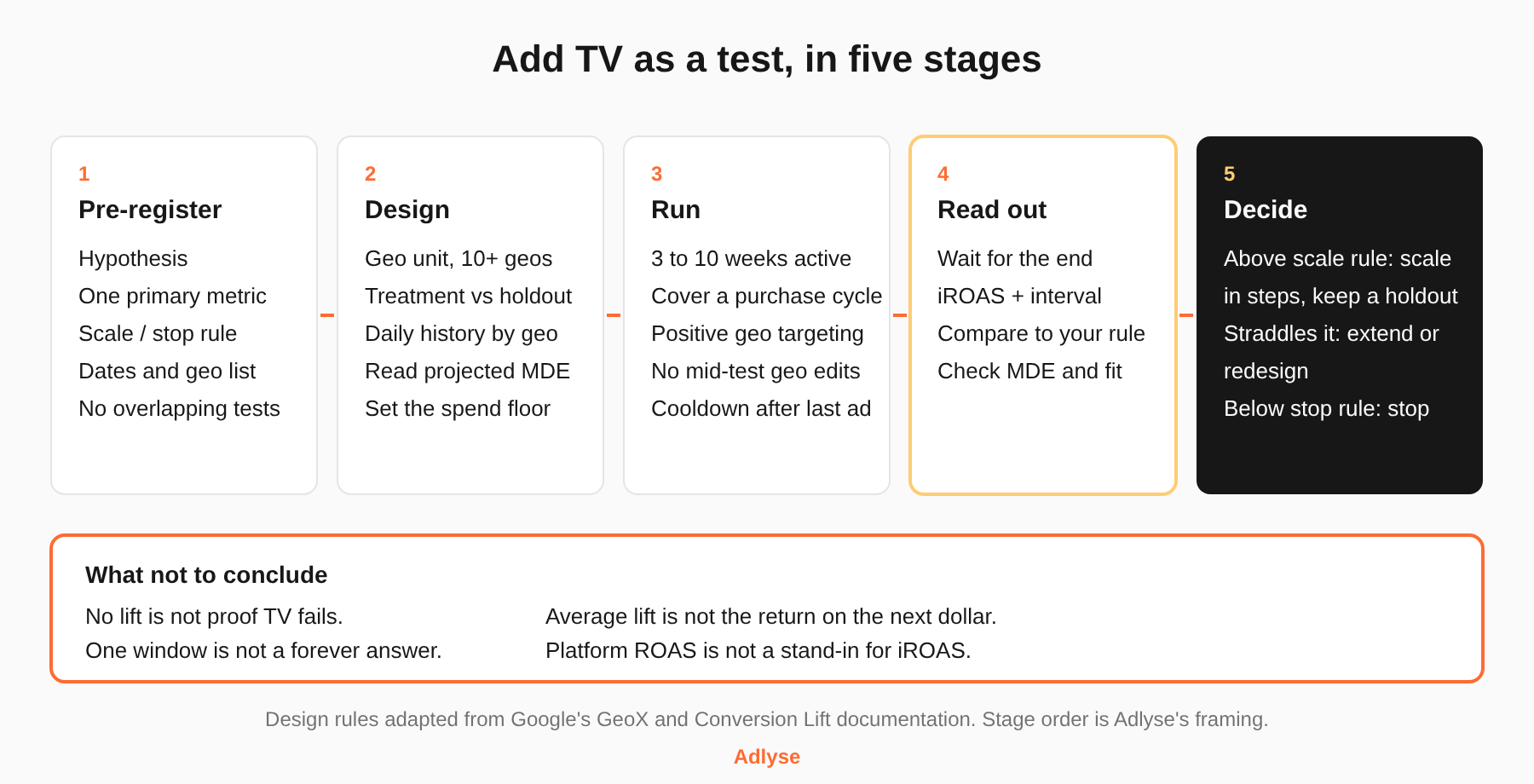
Treat TV as an experiment before you treat it as a budget line. Write the hypothesis and decision rule first, hold out a set of geographies, fund the test large enough to detect the effect you need, then read incremental ROAS with its confidence interval. Buying TV is getting easier. Proving it worked is the part that still takes design.
What changes when TV becomes a channel you can buy like search?
The buying friction is dropping. On Oct. 27, 2026, Universal Ads announced a "Campaign Management" category in its Business Partners Program, according to TVNewsCheck. The stated aim is to let partners build TV activation into the platforms digital marketers already use, so advertisers can plan and manage TV buys without switching tools.
That solves access. It does not solve proof. A report that credits conversions to people who saw the ad will count buyers who would have bought anyway. Exposure is not cause. Adlyse covers why in Incrementality Testing: The Only Measurement That Answers the Question You're Actually Asking and in Attribution Chaos: How CMOs Can Finally Track Real ROI. The short version: a conversion that follows an ad is a correlation until a control group says otherwise.
What should you write down before you spend a dollar?
A pre-registration: one page, dated, agreed by the people who will act on the result. It stops you from picking the flattering metric after the data is in.
- Hypothesis. "Adding TV in the treatment geographies raises total conversions there versus the holdout geographies." Name the channel, the geographies, and the direction.
- Primary metric. One metric. Google's geo-testing guidance says to use raw, unfiltered conversion events, because attributed conversions can bias the causal estimate. Use total orders or leads, not "conversions TV was credited with."
- Test type. For a channel you are adding for the first time, a holdback fits: target only treatment geos and keep control geos strictly held out. Go-dark and heavy-up suit channels you already run.
- Decision rule. The incremental ROAS (iROAS) at which you scale, and the one below which you stop. Set it from your margin, not from the result.
- Fixed dates and geographies. Start, end, cooldown, and the geo list. No edits once live.
- Overlap check. Google lists running overlapping brand lift, conversion lift, or holdout studies as a pitfall. Pause other tests that touch the same geos.
Pre-registration is our term for this, not Google's. The components come from Google's design guidance.
How do you design a geo holdout for TV?
Pick a geography unit, split the units into treatment and control, and make the two groups behave alike before launch.
Choose the unit. Google's implementation guidance describes the trade-off: smaller units give more statistical power and can lower budgets, but people may travel across regions, which can bias the estimate. Country-level units give low power and expensive budgets. Then check that your TV platform can actually target the units you chose.
Count your geos. Google's GeoX FAQ says you should include a minimum of 10 geos for a single-cell design, and recommends 50 to more than 100 when you stratify. It also requires daily time-series data. Weekly data is not supported.
Match the groups. The design tool assigns geos to treatment and control from your history of daily results by geo. Do not hand-pick "good" markets for treatment. If you design by hand, you inherit that bias.
Close the leaks. Google's guidance is to use positive targeting of the exact geos instead of broad national targeting with exclusions. Keep local and offline media balanced between groups, or drop geos where you cannot balance it. Synchronize start and end times across every platform in the test.
Do not touch it mid-test. The same page warns against adding geos to treatment for more spend, removing low performers, or swapping control regions into treatment.
One caveat on tools. Google's Conversion Lift based on geography is built for Google Ads campaign types and is not available to all accounts. It is a model for how to design the test. It will not measure a TV buy placed elsewhere. For that, apply the same design rules to the TV platform's geo targeting. Google describes GeoX as its primary methodology for offline and omni-channel measurement.
How much do you need to spend for the test to mean anything?
Enough to detect the smallest effect you would act on. No source we found publishes a universal minimum. Google's implementation guidance gives no spend threshold, and the budget depends on your geo granularity and the design output.
The mechanism is the minimum detectable effect (MDE). Google's design documentation says the design projects the required budget and the minimum detectable effect. Its FAQ warns that low budgets can restrict you to measuring campaigns with a very low cost per incremental conversion or a very high iROAS.
Turn that into a spend floor in three steps:
- Work out the iROAS you need to break even, from margin.
- Run the design and read the projected budget and MDE for each candidate.
- Set your floor at the cheapest design whose MDE sits below your break-even iROAS.
If the budget for that design is more than you will commit, do not run a weaker version and call it a test. Either extend the duration, which Google notes can lower the MDE (for example from four weeks to six or eight), or wait.
How long should the test run?
Long enough to cover one purchase cycle, plus a cooldown. Google's implementation guidance puts active testing at typically 3 to 10 weeks, and 7 to 14 weeks from pretest planning to analysis. It says the window should cover at least one purchase cycle. Early weeks may be warm-up, and automated bidding needs its learning period.
Keep a cooldown after the last TV impression so lagged conversions land. Google's FAQ recommends a 1 to 2 week cooldown, and its implementation page recommends 2 or more weeks when conversion lag could push effects past the test period. If your sales cycle is long, take the longer figure.
Do not read it early. Google's results guidance says to wait until the end of the study for the most accurate results.
How do you read the result?
Read incremental ROAS and its range together. Google defines iROAS as incremental conversion value divided by incremental cost. Its worked example: an iROAS of 2 means each $1 invested produced $2 of net new conversion value, and a point estimate of 2.2 can come with a range of 1.3 to 3.5. That is Google's illustration, not a TV benchmark.
Then compare the interval to your pre-registered rule:
| Result | What it means | What to do |
|---|---|---|
| Interval sits entirely above your scale threshold | Evidence TV paid back at this spend, in this window | Scale in steps and keep a holdout |
| Interval straddles your threshold | Not proven either way | Extend the test or rerun with a better design |
| Interval sits below your stop threshold | TV did not pay back at this spend | Stop, or change the creative or targeting and test again |
| No significant lift detected | The test could not separate the groups | Check the MDE and fit before concluding anything |
For the last row, Google's FAQ gives two checks. Confirm that you believe the campaign can achieve a lift larger than the MDE, and look at model fit. A low R-squared, such as under 0.5, indicates the control geos do not predict the treatment geos well.
What should you not conclude from one TV test?
- "No lift means TV does not work." Google says a neutral result does not necessarily mean failure. An underpowered test cannot tell you either way.
- "The iROAS is the return on the next dollar." A holdback or go-dark test measures average incremental lift. Meridian's documentation says experiments measuring marginal lift against reduced spend introduce an estimand mismatch with the model's zero-spend counterfactual. Do not assume doubling spend doubles the return.
- "This result holds forever." The same page notes the further an experiment is from today, the less likely its results reflect the current business reality. Retest after major creative, pricing, or seasonal changes.
- "A short test captured the full effect." The page also warns a short experiment may miss the full, longer-term effect of media spend.
- "Platform ROAS now matches the test." Treat the iROAS as your reference point and judge dashboards against it. Our guide to reading cross-platform numbers explains why the figures disagree.
The IAB's guidelines for incremental measurement, written for commerce media, give the same three principles in general form: credible counterfactuals, control of bias, and separation of signal from noise. A geo holdout is a credible counterfactual. Everything above protects the other two.
What happens after the test?
Feed it forward. Meridian's CalibrationBuilder translates experiment results into ROI priors, so a clean test improves your marketing mix model. We cover the model side in Google's Data Strength Uplift Metric and Meridian MMM Upgrades. For the habit of tying every change to a result, see How to Prove Which Change Drove Performance.
What should you do next?
Write the one-page pre-registration before you open a TV buying screen. Whatever tool you buy through, the hypothesis comes first. Adlyse works the same way on the channels it runs: it executes approved changes across Google, Meta, Microsoft, TikTok and OpenAI/ChatGPT Ads, ships each change with a hypothesis, and grades it improved, hurt, or neutral. For transparency, TVNewsCheck lists Adlyse among the launch partners in the Universal Ads announcement.