
Freeze structure and goals 14 days before Black Friday, not budgets. In 2026, Black Friday is November 27, so that means no new bid strategies, no moving campaigns in or out of one, no conversion-goal edits, and no significant Meta ad set edits after Friday, November 13. Budgets and single, deliberate target moves can continue, because Google says they do not trigger a learning status.
Why does a Black Friday change freeze matter?
Because both platforms need time to settle after a change, and the event is short. Google says the learning period for a bid strategy "never lasts more than 7 days", and that performance can take "up to 1 to 2 conversion cycles" to stabilize after a new ROI goal. Meta's developer guidance says an ad set's learning period stabilizes with a minimum of 50 events over a 7-day period and that changes can trigger a new learning period.
Do the math on a late edit. A structural change on Monday, November 23 leaves the account re-learning on Black Friday, four days later. The same change on Thursday, November 12 has more than two weeks to settle.
That is the whole case for a freeze. It is not caution for its own sake. It keeps the algorithms stable for the four days (Friday to Monday) when you can least afford a re-learn.
What does Google say triggers a learning period?
Google's page lists three triggers:
- A new or reactivated bid strategy.
- Campaigns, ad groups, or keywords added to or removed from a bid strategy.
- A significant change to the conversion goals or actions you optimize to.
Those are the same triggers Google documents, and they are your lock list. In practice, that covers swapping Target CPA for Target ROAS, merging campaigns under one strategy, splitting a campaign out, and re-ranking primary conversion goals.
The consolidation point cuts the other way too. Google recommends consolidating ad groups and campaigns to pool conversion data. That is good advice, and it belongs in the change window, not the freeze.
What can you still change during the freeze?
More than most freeze documents allow. Google states that changes to budgets, targets, creatives, or targeting settings "never remove your historical data or trigger 'Learning' status", and that target changes take effect in the next auction.
Two cautions come from the same page:
- "Learning" is not the same as "stable." Google says it can take up to 1 to 2 conversion cycles for performance to stabilize to a new ROI goal. If your conversion cycle is a week, a target change made on Wednesday, November 25 may still be settling on Black Friday.
- One move, not several. Google advises avoiding multiple target changes within a single conversion cycle unless there is a clear business need. Pick the target, change it once, and write down why.
On Meta, the picture is less clear. Meta's Marketing API reference says significant edits cause ad sets to re-enter the learning phase, but the page does not list which edits count. Meta's developer guidance recommends keeping adjustments minor and avoiding significant edits.
Budget size is the open question. Jon Loomer, who writes about Meta advertising, describes Meta's explanation as a small increase being fine and a very large one restarting learning, with no stated safe percentage. Treat that as secondary reporting. Until you have checked Meta's current wording, make Meta budget moves in small steps, not one jump.
How do you audit Meta ad sets before the freeze?
Pull the learning status for every Black Friday ad set on Thursday, November 12 and again on Tuesday, November 24. The Marketing API exposes this on the ad set. The learning stage info reference defines three statuses:
- LEARNING: the ad set is still learning.
- SUCCESS: the ad set exited the learning phase.
- FAIL: the ad set is not generating enough results to exit.
It also returns a timestamp for the last significant edit that sent the ad set back into learning. That timestamp tells you which ad sets someone touched during the freeze.
Any ad set in LEARNING on November 12 gets a decision: let it finish, or accept it will go into the event still learning. Any ad set in FAIL gets consolidated or given a budget that can produce enough events, and that happens before November 13. Meta's own help page on the learning phase is the place to check the current list of significant edits. This post does not restate it.
Should you use a seasonality adjustment for Black Friday?
Only if you expect conversion rates to move a lot. Google calls seasonality adjustments an advanced tool for telling Smart Bidding about expected conversion-rate changes and says to use them only when you expect major changes, because Smart Bidding already manages seasonal events.
The details that matter for BFCM:
- Duration. Google says they suit short events of 1 to 7 days and may work less well beyond 14 days. Friday to Monday is four days.
- Supported setups. Search, Shopping, Demand Gen, and Display campaigns on Target ROAS or Target CPA, and Performance Max and App (beta) campaigns on any bid strategy. Not Travel campaigns.
- The end. Campaigns return to normal afterward, and you do not need a negative adjustment when the event ends.
- The estimate. Google's own example is a 3-day sale where you expect a 50% lift, so you add up to a +50% conversion rate adjustment. The 50% is an illustration, not a benchmark. Base your number on your own conversion rate in a comparable past sale, and if you do not have one, skip the adjustment.
Create the adjustment in the change window, since it is a settings change, and put its dates in the calendar below. Google's create-an-adjustment page walks through the steps under Tools, Budgets and bidding, Adjustments.
When do you use a data exclusion instead?
When the data is wrong, not when the demand is different. Google describes data exclusions as a tool to reduce the impact of conversion tracking issues in Smart Bidding, and recommends them for conversion data outages: broken tracking, misplaced tags, or offline conversion uploads that cannot be sent. For known future problems, such as scheduled site maintenance, you can set one ahead of time.
The limits are strict:
- Google says not to use them frequently or for prolonged periods.
- Do not remove an exclusion once applied.
- Backfilling is generally discouraged, and if you backfill for reporting, wait at least 5 days.
- You may still need to adjust targets and budgets while performance settles.
The split is simple. A seasonality adjustment says "conversion rate will change, and that is real." A data exclusion says "these conversions are not trustworthy." Google's data exclusions page does not draw that comparison, so this one is our reading of the two definitions.
If your site team plans a checkout or platform freeze of its own, get the dates now and decide whether any of it needs an exclusion.
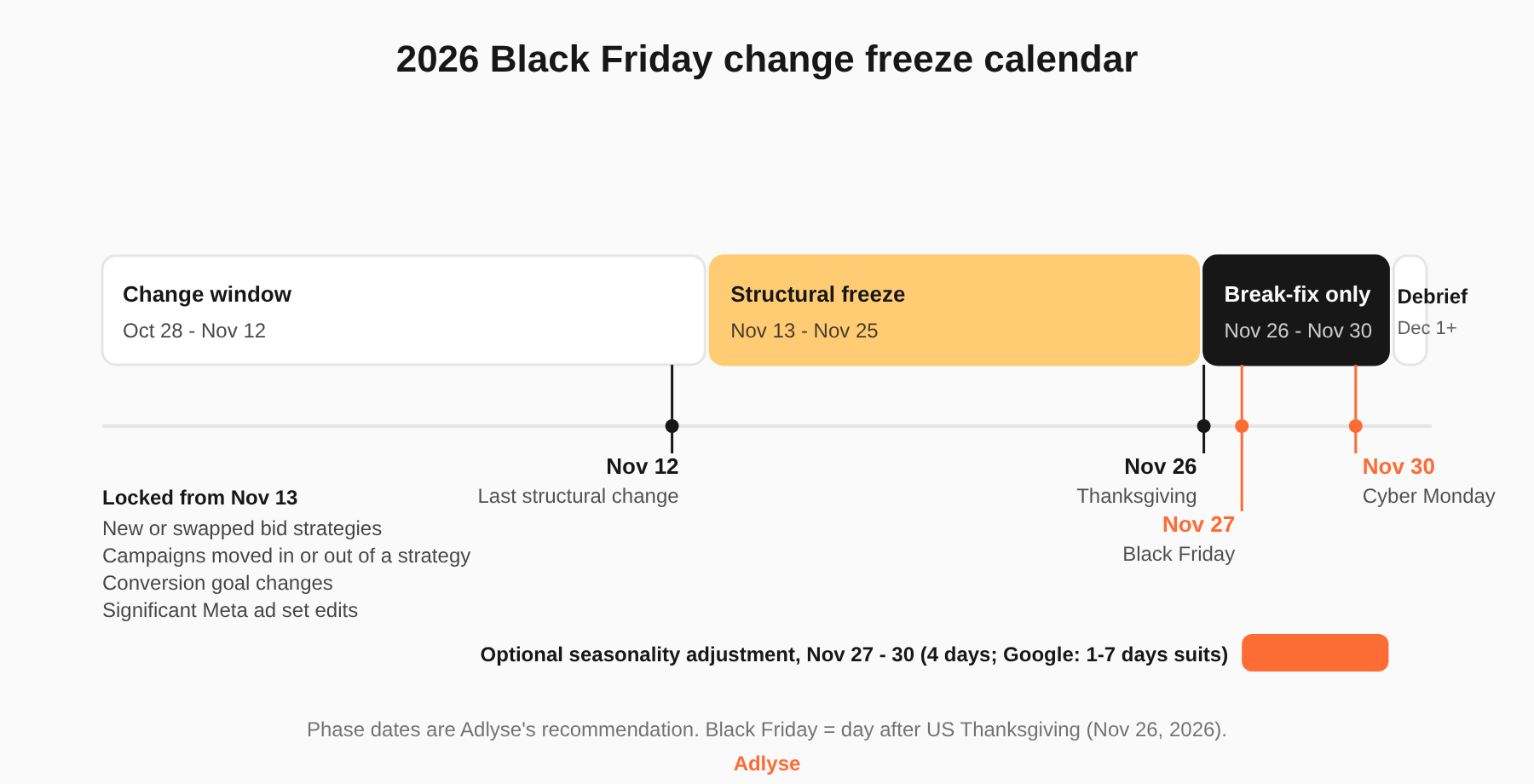
What does the 2026 freeze calendar look like?
Thanksgiving Day 2026 is Thursday, November 26 per the National Archives, and the statute defines it as the fourth Thursday in November. Black Friday falls on the day after US Thanksgiving, which makes it November 27. Shopify gives Cyber Monday 2026 as November 30.
The phase dates below are an Adlyse recommendation, not a platform rule. The 14-day line comes from two things: Google's 7-day learning ceiling and its advice to judge results over two conversion cycles or a two-week window, whichever is longer.
| Dates (2026) | Phase | You can change | Locked |
|---|---|---|---|
| Wed Oct 28 to Thu Nov 12 | Change window | Bid strategies, campaign structure, conversion goals, new campaigns, Meta ad set rebuilds, the seasonality adjustment | Nothing, but finish by Nov 12 |
| Fri Nov 13 to Wed Nov 25 | Structural freeze | Budgets, one target move per campaign, Google creative, tracking fixes | Bid strategy swaps, strategy membership, conversion goals, significant Meta edits |
| Thu Nov 26 to Mon Nov 30 | Break-fix only | Fix broken tracking, pause disapproved or broken ads, budget changes that stop a cap from choking spend | Everything else |
| Tue Dec 1 on | Debrief | Review results by change | Wait before cleanup |
Google creative sits in the allowed column because Google says creative changes do not trigger a learning status. New Meta ads are not in that column, because the open question above covers them. Test new Meta ads before November 13.
For the budget side of this plan, including how to set pacing before the event, see Q4 and BFCM Pacing with Agents: The Plan You Write in August. That post covers how much to spend and when. This one covers what you leave alone.
Who approves an exception during the freeze?
One named person, with a written reason. A freeze with no exception path gets broken quietly at 11 p.m. on Black Friday. A freeze with a clear path stays intact.
Define break-fix before the freeze starts. Tracking is down. An ad is disapproved. Spend is capped while the account has budget to give. Everything outside that list waits for December 1.
Log every exception with what you changed, what you expected, and when you will check. That log is also the record you need afterward. An Audit Trail for AI-Driven Ad Spend covers what it should include, and AI Autonomy in Ad Spend: The Guardrails That Actually Matter covers how to set limits when software, not a person, is making the change. The platform-specific guides, Google Ads + AI Agents and Meta Ads + AI Agents, cover how those accounts behave when automation is involved.
What should you do next?
Open each Google bid strategy and Meta ad set that will carry Black Friday spend and mark it as final or open. Anything open gets finished by Thursday, November 12. Then write the break-fix list, name the exception owner, and put November 13 in every team calendar.
If an agent makes changes in your accounts, give it the same calendar. Adlyse executes approved changes across Google, Meta, Microsoft, TikTok and OpenAI/ChatGPT Ads (per its site), ships each change with a hypothesis, and grades it improved, hurt, or neutral. After Cyber Monday, that record shows which changes helped and which hurt.