
Instagram is testing a new upload type called Features that allows videos up to 90 minutes long. TechCrunch reported the announcement on October 26, 2026. For advertisers, the key point is what is missing: Meta has not confirmed that ads will run in long-form videos. Treat this as a creator and organic format for now, and change nothing in your paid plan until Meta says otherwise.
What did Instagram announce?
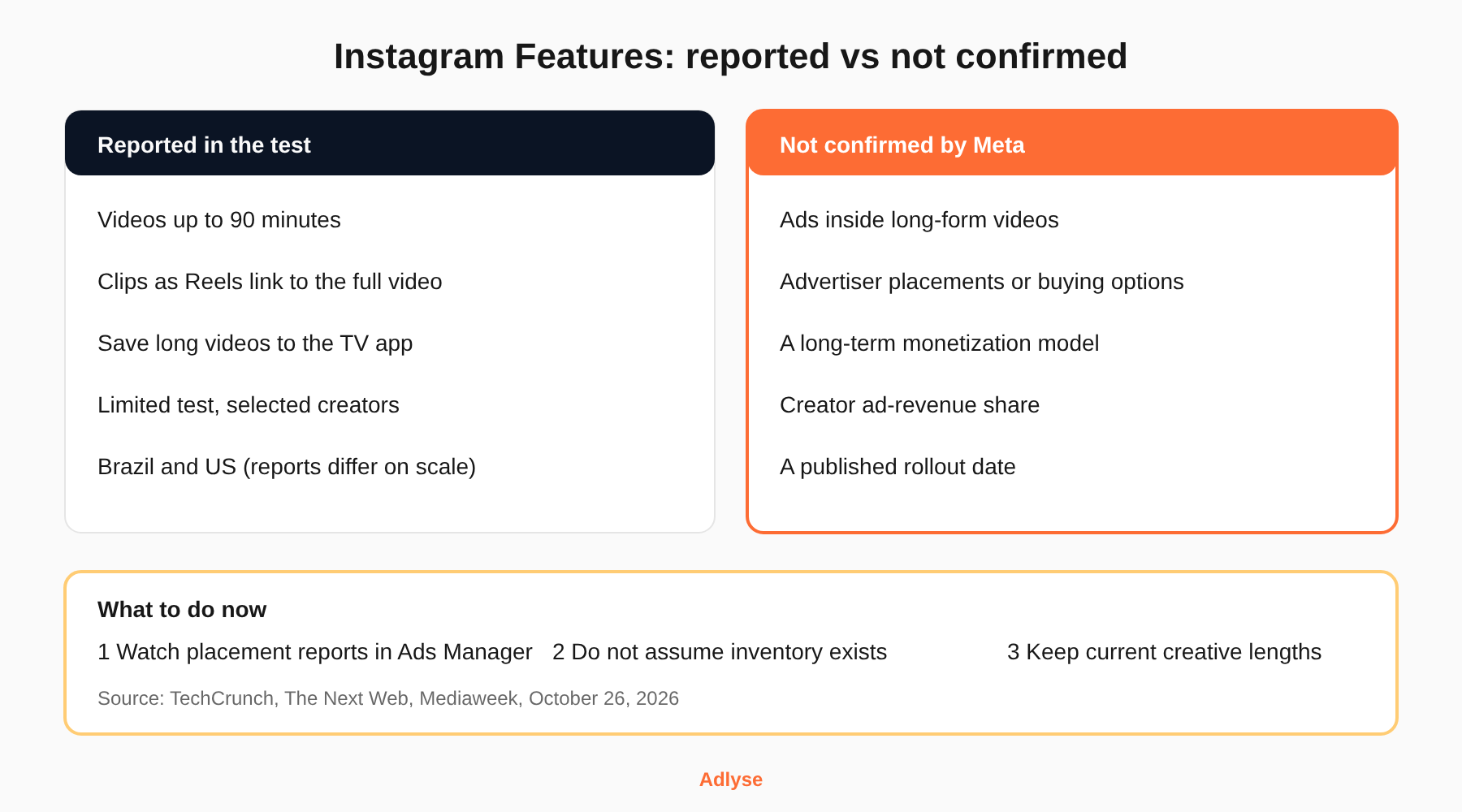
Instagram announced a test of a new upload type called Features, which lets creators post videos up to 90 minutes long (TechCrunch, October 26, 2026). Adam Mosseri, head of Instagram, and Tessa Lyons, Instagram's VP of Product, are the executives quoted in TechCrunch and The Next Web.
Three pieces make up the test:
- Features: long uploads, up to 90 minutes. The Next Web and Mediaweek describe them as horizontal video that appears in the main feed and on Explore.
- Clips as Reels: creators turn long-form content into Reels, and each Reel links viewers to the full video (TechCrunch).
- TV saving: viewers can save long-form videos to send to the Instagram app on their TV (TechCrunch).
Instagram has tried long-form before. TechCrunch notes it shut down IGTV, its earlier long-form video product.
Where is it available, and who gets it?
Reports differ on the details, so avoid repeating any one version as fact.
- TechCrunch says Features and Clips as Reels are being tested in Brazil and will expand to a small test in the US.
- The Next Web says the test starts with a small group of US creators, with some Brazilian creators also taking part, citing an Instagram spokesperson speaking to The Verge.
- Mediaweek says Instagram plans to grow the US test to tens of thousands of creators, and that no eligibility criteria or full rollout timeline have been published.
All three agree on the core: it is a limited test, aimed at creators such as podcasters and comedians. We found no Meta-published rollout date. We could not open Instagram's own announcement post, so these details come from news reports.
Will there be ads in 90-minute Instagram videos?
Not confirmed. That is the answer to plan around.
TechCrunch reports that Meta has not confirmed whether it will put ads in long-form videos, even though Meta earns most of its revenue from advertising. A Meta spokesperson told TechCrunch: "It's too early to share a long-term monetization model." Mediaweek reports that Instagram does not currently plan to share Features ad revenue with creators and has not ruled out changing that.
Note what that does and does not say. It says no creator revenue share is planned for now. It does not say whether advertisers will get placements in the format. Both questions are open.
For comparison, TechCrunch reports that YouTube Partner Program creators receive 55% of ad revenue from their videos. Instagram has announced nothing like that. TechCrunch also quotes Mosseri saying Instagram's performance-based creator program costs more than it earns, which suggests Meta is not rushing to pay per view.
What does it mean for your Meta ad account today?
Nothing changes in your account because of this announcement. None of the reports we read describes a new ad placement, ad format, or buying option for Features. Mediaweek reports one thing that touches brands: established creators can bring their existing brand and advertising deals to Features, and Instagram is working on "a few different deals" with early creators.
That points to the near-term commercial route. Creator-led sponsorships, not Meta ad inventory. If the test grows, the first brand activity will likely sit inside creator content.
Two second-order effects are worth watching, as inferences rather than facts:
- Attention may shift. TechCrunch reports Mosseri saying short Reels drive more shares and DMs. Long-form changes what people do in the app. Whether it moves attention away from Reels is unknown.
- Reels clips may get more traffic. If Clips as Reels works, more Reels will link to long videos. How that affects your Reels ad costs or reach is untested.
Neither effect has data behind it yet. Don't forecast with them.
What should advertisers do now?
Short list. None of it needs new budget.
- Watch your placement reports. Check your placement breakdown in Ads Manager on your normal reporting cadence. If Meta ever adds a long-form placement, check whether it appears there. Do not assume your ads are running in Features, and do not assume they are not, until Meta documents it.
- Don't assume inventory. If you use automatic placements, you already let Meta choose where ads show. Before any new surface is added, decide whether you want to opt in or review it first. Write that rule down now.
- Keep your creative length as is. Your short-form ads are unaffected. Do not commission 90-minute brand content for paid use on the strength of a test with no confirmed ad format.
- If you work with creators, ask the question. Ask any podcaster or comedian you sponsor whether they are in the test, and whether a Features sponsorship would be priced differently. Mediaweek says Features videos will not be exclusive to Instagram, so a deal can span platforms.
- Plan around Q4, not this. Your holiday budget decisions should rest on current formats. Our Q4 and BFCM pacing guide covers budget pacing.
- Log what you decided. A one-line note saying "no ad format confirmed for Features as of October 28, 2026" is useful when someone asks in January.
How does this fit with Meta's other recent video moves?
Meta has been adding video surfaces and ad formats at a steady pace. Earlier this month we covered Instagram Live video ads and what they mean for Q4. Features is different. Live video came with an ad product. Features, so far, has none.
Meta's subscription and AI products are also changing what advertisers can access. See what Meta One's subscription tiers gate and our Meta Ads and AI agents guide. If you let agents or automation change placements and budgets, set limits first. The guardrails that actually matter is a good starting point.
What should you do next?
If agents manage any part of your Meta account, the useful habit here is the same as always: make a change only with a hypothesis, then check whether it helped. Adlyse executes approved changes across Google, Meta, Microsoft, TikTok and OpenAI/ChatGPT Ads, ships each one with a hypothesis, and grades the result as improved, hurt, or neutral. A new surface with no confirmed ads is a good reminder to keep that discipline.