
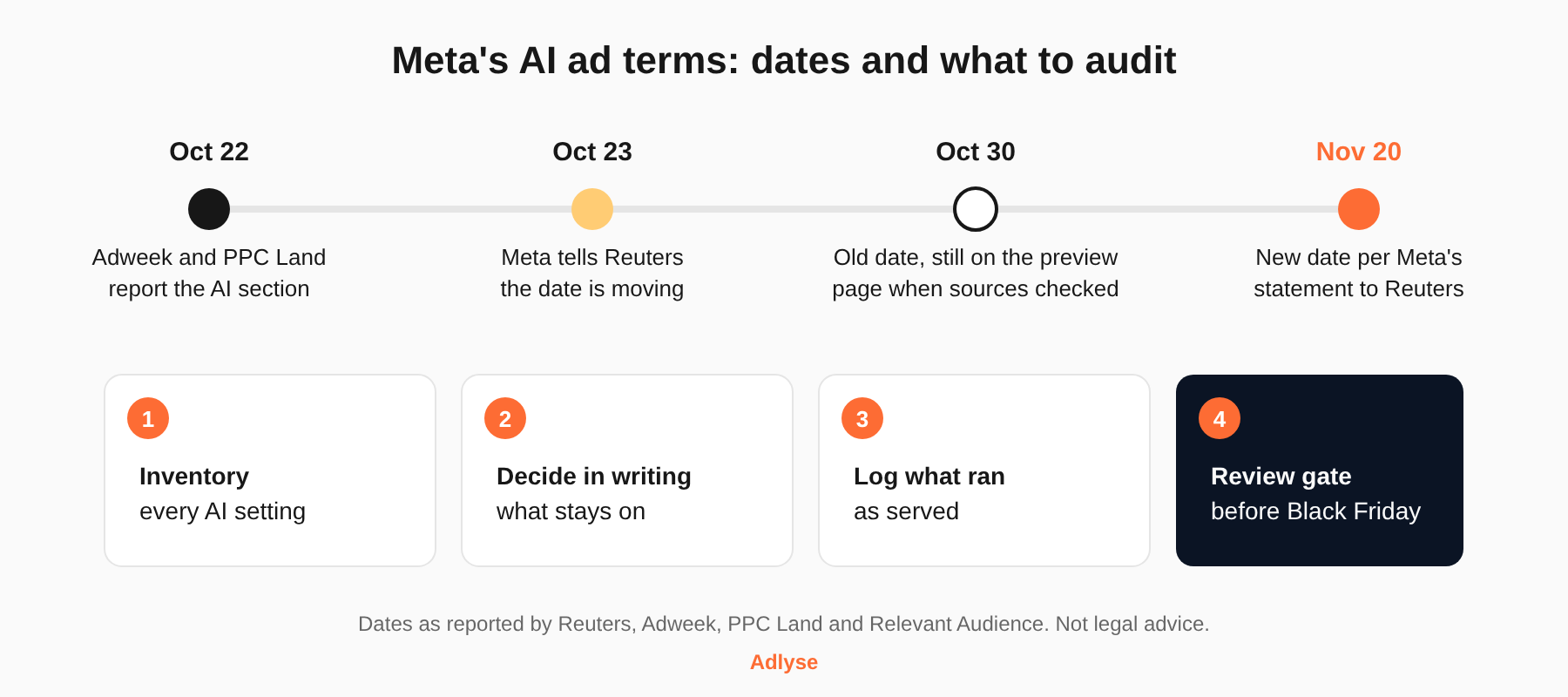
Meta has pushed the effective date of its updated Commercial Terms and Self-Serve Ad Terms from October 30 to November 20, 2026. A Meta spokesperson told Reuters, in a report dated October 23, 2026, that "we are extending the effective date of our updated Commercial Terms and Self-Serve Ad Terms to 20 November." The delay gives you three more weeks, not a different deal. The reported wording on AI features did not change, so use the time to audit your Advantage+ settings, log what Meta's AI edits, and get counsel to read the terms. This is not legal advice.
What did Meta actually announce on October 23?
The only on-the-record statement is the one to Reuters. Meta said the extra time lets it "explain to our partners and stakeholders what's changing and what's not," according to PPC Land's coverage of the report. Reuters also reported that Meta will clarify how it uses web crawlers and confirm that content owners can still use robots.txt.
Two limits matter:
- The delay covers both documents: the Commercial Terms and the Self-Serve Ad Terms.
- Relevant Audience reports that Meta announced no wording changes. The one revision on record, dropping the word "train" from the crawling clause, came before the delay.
Reuters' own assessment was that the delay could head off regulatory action. That is Reuters' view, not a Meta statement. The European Commission welcomed the delay, per the same reports. Publisher groups said a pause is not enough.
Does Meta's own page show November 20 yet?
Not when the sources checked. Relevant Audience reported that Meta's preview page, facebook.com/legal/commercial_terms_preview, still carried the banner "These updates will come into effect on 30 October 2026" on October 24. Its footer also still read October 30. PPC Land saw the same October 30 date on the UK English preview about seven hours after the Reuters report, and a reader reported the French version still showed it. PPC Land also noted that a UK trade body said the top of the page showed November 20. The sources disagree on this point.
I could not fetch Meta's preview page for this article. Everything about its wording below comes from Adweek, PPC Land, and Relevant Audience, and I quote it only as they reported it. Before you act, read the live page yourself. If the pages and Meta's statement disagree, ask Meta in writing which date governs. PPC Land notes Meta has not said.
What do the new terms say about AI features?
Adweek's reporter Trishla Ostwal, writing on October 22, described a new "AI Features" section. As reported:
- Meta's AI features "may make mistakes and may not always produce accurate, complete, or suitable results."
- The advertiser bears "any and all risks."
- Advertisers are "solely responsible" for what the features create or change, including features Meta switches on itself.
The earlier wording was narrower, according to Adweek. Advertisers were responsible for AI output when they chose to use Meta's AI tools. PPC Land's earlier report adds that the new section appears to drop that condition, but it could not check the full text against Meta's page.
Other reported provisions that still apply:
- Continued use after notice counts as acceptance. There is no signature step.
- Advertisers who disagree may stop using Meta's products for business purposes.
- Businesses indemnify Meta against third-party claims tied to their content or actions.
- Meta's liability is capped at the greater of $100 or what you paid in the previous twelve months.
Meta says it is folding its generative AI ad terms into its main ad terms and called the update housekeeping. It did not directly say whether an advertiser is liable for a feature it never turned on. It pointed to the Advantage+ opt-out settings in Ads Manager. The "100% of the legal liability" description is a quote from an AdCellerant director, not contract text.
Whether that reading holds is a question for your lawyer, not for a blog.
Why are advertisers pulling ads?
Adweek reported cases where AI edits ran without a deliberate opt-in:
- Bookshop.org said an automated account update opted it into a generative AI feature, and Meta added an AI illustration to a human-made ad. It has turned off all of Meta's AI ad features.
- Exverus, a digital agency, reported sitelinks, translated copy, and AI images and carousels appearing on campaigns where advertisers had not enabled them. It pulled live ads. Its specialist said many options sit in collapsed menus and still apply unless unchecked one by one.
- AdCellerant turns off Meta's default AI automation on every campaign.
- Go Fish Digital is having its legal team review the terms. It told Adweek it would not advise clients to pull back on Meta in Q4.
These are the advertisers' own accounts as Adweek reported them. Meta did not answer Adweek's specific questions about them.
What should you audit before November 20?
Treat this as an ops problem with a deadline, not a debate. Four steps.
1. Inventory every AI setting, per campaign. Open each active campaign and ad in Ads Manager and list which Advantage+ features are on: creative enhancements, generated media, translations, added sitelinks, and any product browsing defaults. Check collapsed menus. Exverus said that is where options hide.
2. Decide what stays on, in writing. For each feature, record on, off, or on for a test budget only. Name the person who decided and the date. If a client's brand rules forbid AI-generated imagery, turn it off at the campaign level and check again after any account update.
3. Log what actually ran. Screenshot or export the live ad as served, not just the ad you uploaded. Keep the original asset next to it. If a dispute starts, you need a record of what the ad looked like on which day. Our audit trail guide lists what a useful log contains.
4. Add a review gate before Black Friday. Put a named reviewer on any ad that carries an AI edit, with a check for factual claims, prices, and brand fit. Go Fish Digital's David Dweck told Adweek the timing puts advertisers a month before Black Friday and Cyber Monday, so keep the review step small and fast. Our guardrails post covers where to set approval thresholds.
What should agencies check in client contracts?
If you run accounts for clients, the terms may land on you and on them. Ask counsel to read these points:
- Who accepts the terms. Continued use is acceptance. Find out whose business account that binds, yours or the client's.
- Who is responsible for AI-edited ads. Does your master services agreement say who owns an error that Meta's AI introduced? Many contracts were written before this question existed.
- Indemnity flow. If the client indemnifies Meta, does your agreement pass any of that to you?
- Client approval of AI features. Get a written yes or no per client on which AI features run. Our client transparency playbook shows how to present this.
- Data and compliance language. Check against the questions in our compliance and privacy guide for agent-run accounts.
If you are a US business, PPC Land reports a 30-day window after first acceptance to opt out of arbitration, which it estimates would close around December 20 if acceptance falls on November 20. Have counsel confirm the real dates.
What should you do next?
Run the audit this week, while the terms are still pending. If you want an agent doing the execution side, Adlyse executes approved changes across Google, Meta, Microsoft, TikTok, and OpenAI/ChatGPT Ads, and ships each change with a hypothesis and a grade, so changes in your account have a record. For the wider Meta picture, see our Meta Ads and AI agents guide.