
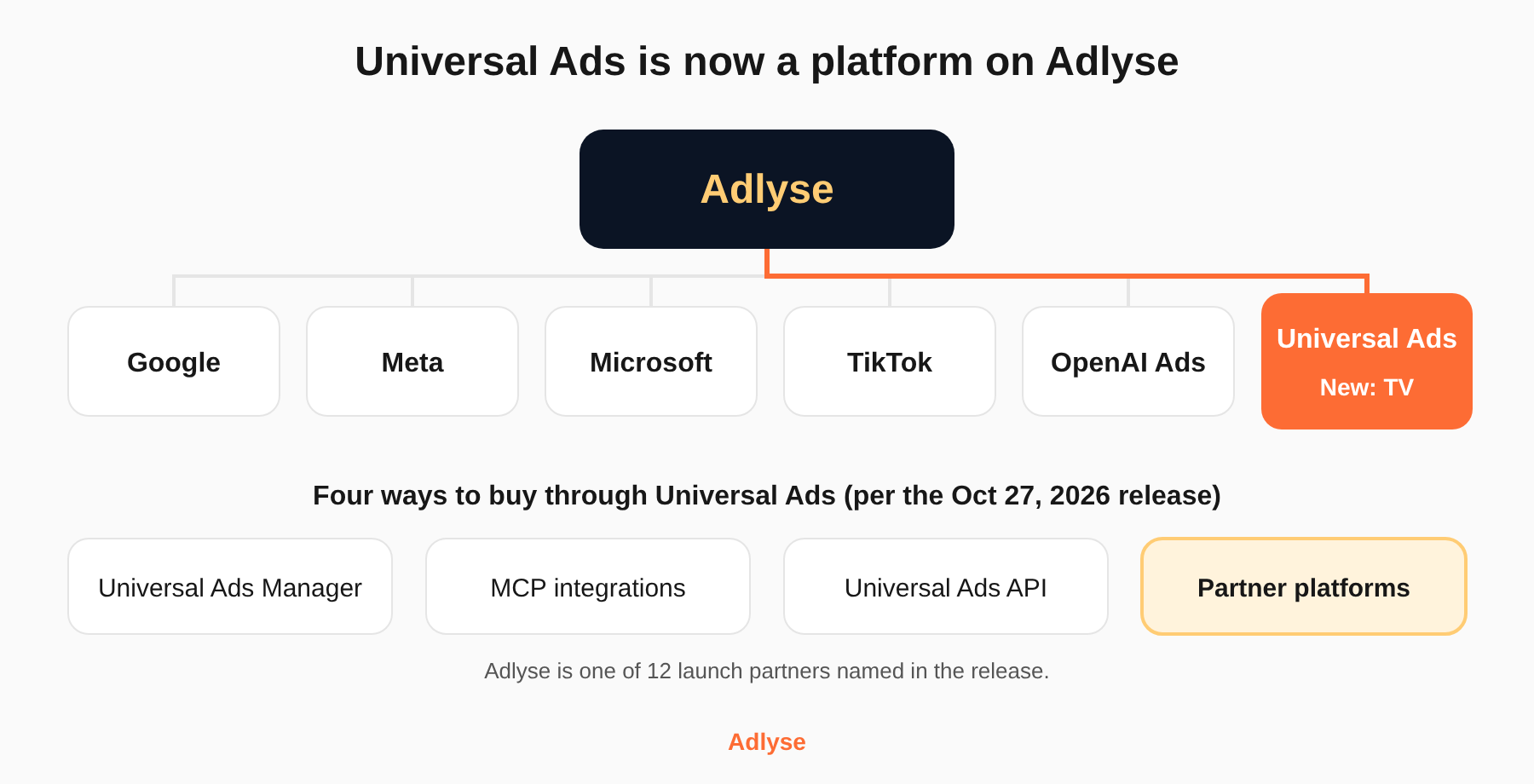
Universal Ads is now a platform on Adlyse. That puts TV in the same place you already run Google, Meta, Microsoft, TikTok and OpenAI Ads. Universal Ads is Comcast Advertising's self-service platform for creating, buying and measuring premium video ads. On October 27, 2026, it named Adlyse as one of 12 launch partners in a new Campaign Management category of its Business Partners Program (release as republished on Yahoo Finance).
What does Universal Ads on Adlyse mean for your media plan?
It means TV can be one more platform in the plan, not a separate login and a separate process. Until now, Adlyse covered five ad platforms: Microsoft, Google, Meta, TikTok and OpenAI Ads. Universal Ads is the sixth, and it is the first one that sells television.
The reason this matters is the plan, not the screen. When TV sits beside search and social, you can compare what each channel was asked to do and what it did, using the same hypothesis-and-result habit you apply everywhere else. That habit is the point of the rest of this post. It also keeps TV honest: a channel that cannot be tied to a stated goal and a graded result should not hold a budget line for long.
What is Universal Ads?
Universal Ads is Comcast Advertising's self-service platform for creating, buying and measuring premium video ads, per the release. Its own site describes a self-serve account with no upfront commitments and a Marketing API you can build on "to automate campaigns, reporting, and attribution."
Per the release, there are four ways to buy:
- Universal Ads Manager. The platform's own interface.
- MCP integrations. MCP is the Model Context Protocol, a standard for connecting AI tools to other software.
- The Universal Ads API. For teams that build their own workflows.
- Partner platforms. Tools that have built Universal Ads buying into their product.
Adlyse is in that fourth group. The release says the aim is that advertisers plan TV next to search, social and other digital channels without switching tools. Daniel Druger, VP of Product at Universal Ads, says advertisers "should not have to change the way they work in order to add TV to their media plans."
What did the October 27, 2026 announcement say about partners?
The announcement is titled "Universal Ads Brings TV Buying into the Flow of Modern Media Buying." The Yahoo Finance copy shows it as a Business Wire release dated October 27, 2026, and notes it is a paid press release. TVNewsCheck covered the same launch.
The launch partners are Adlyse, Atrium, Concord, Kochava, Koddi, Olyzon, Orbee, Scale Up, SearchKings, Stellair AI, Topsort and WorkMagic. Universal Ads lists the same 12 on its partners page. The release says more will join, and that the group spans agentic buying, creative-led buying, measurement, commerce and retail media, and agency tools.
Disclosure: Adlyse publishes this blog and is one of the 12 partners.
What does "no markups, upfront commitments or contracts" cover?
The release says Universal Ads has no markups, no upfront commitments and no contracts. Universal Ads' site makes similar claims: "no hidden fees" and "No contracts, no intermediaries".
Read that as a statement about Universal Ads' own terms. The sources we read do not say what TV inventory costs, what a practical minimum spend looks like, or how billing works when you buy through a partner. Put those questions to any partner before you move a budget line, ours included.
What should you decide before TV joins the plan?
This section is our opinion, not part of the release.
Start with a question, not a budget. Decide what you want TV to change: branded search volume, new customers, or blended efficiency. Write it down before launch. For background on agent-run buying, see what agentic advertising is.
Cap the first test. Set a spend ceiling and an end date, and require that a person approves the plan before money moves. If an agent can take actions over MCP, know which ones are read-only and which can spend. In May 2026, Universal Ads described its MCP beta as covering performance queries and suggestions, with creating and launching campaigns not yet in scope. The October release lists MCP as a way to buy but does not list what it can do today. See AI autonomy and ad spend guardrails for how to set the limits.
Plan the read before you spend. Conversions reported by the channel that sold you the ad are a weak basis for a budget decision. Our incrementality testing guide covers how to test whether a channel caused the lift.
Vet every partner the same way. Twelve partners at launch is a wide field, and each one connects to Universal Ads differently. Our guide to evaluating agentic AI marketing tools lists what to ask before a tool touches live spend. It applies to us as much as to anyone else.
Decide where the numbers live. TV adds one more set of metrics that will not match search and social. Pick one source of truth first. See why cross-platform numbers do not add up.
What does the release leave out?
A press release is a launch statement, not a spec. Based on the release copies and the news coverage we read, these items are not covered:
- Media pricing and delivery. No CPMs, no reach figures, no results.
- Measurement method. Universal Ads' site mentions real-time reach, delivery and conversion signals through the Universal Ads Pixel, but not how a TV conversion is attributed or tested for lift.
- Approval and permission controls for agents or partners buying on your behalf.
- Which formats are available through a partner versus Universal Ads Manager.
None of this means the launch is weak. It means the facts you need to budget are not in the announcement. Ask for them before you commit spend.
What should you do next?
If TV is joining your plan, hold it to the same standard as every other channel: a stated hypothesis before spend and a graded result after. That is how Adlyse works across its platforms. It executes approved changes, ships each one with a hypothesis, and grades it improved, hurt or neutral. Universal Ads is now one of them.