
- Execution hours were always a proxy for value, not the value itself. The proxy broke; the value didn't.
- Four things stay billable: strategy and prioritization, the approval judgment, verdict-pattern interpretation, and the relationship.
- A graded change record is a new, nameable deliverable. Price it as a line item or it becomes an unpriced expectation.
- Five models are viable, hourly, retainer, performance-linked, value-based, hybrid. Each has a failure mode worth naming out loud.
- Some agencies should not reprice at all. There's a specific test for which ones.
If a system executes the bid changes, budget shifts, and pausing your team used to do by hand, you bill for the things that always justified a strategist's rate, deciding what to test, judging what ships, and reading what a pattern of results means for the account, plus one deliverable manual execution never produced cleanly: a documented record of every change, its stated prediction, and whether it worked. What stops being defensible is charging primarily for hours spent doing work that now takes an approval click.
The catch is that this is not really a pricing problem. It's a disclosure problem wearing a pricing problem's clothes. Most agencies could survive repricing. What they can't survive is a client discovering the automation on their own, mid-contract, and retroactively reinterpreting every invoice they've already paid. The order of operations matters more than the model you land on.
Why does billing for execution hours stop working?
Because the client can now verify the premise. Platform-native automation is in every ad account by default, third-party tools advertise their optimization loops openly, and any client with a curious ops person can find out roughly what a change costs to make. An invoice built around execution hours invites a question you don't want asked: how long did that actually take?
The deeper issue is that hours were never the thing being sold. A client paying $8,000 a month was never buying 53 hours at $150. They were buying an outcome, and hours were the unit everyone agreed to pretend measured it. That fiction held for as long as hours correlated with output. When a strategist's weekly console time drops and the account still improves, the correlation breaks, and the fiction breaks with it.
Here is the honest version of the math. Say a strategist bills at $150/hour and spends 10 hours a week in ad consoles executing changes, that's $1,500 of billable capacity a week, roughly $6,000 a month per strategist. If automation compresses that 10 hours to 2 (review and approve rather than build and execute), an hourly model bills $1,200 a month for the same account instead of $6,000. Run your own rate and your own hours; the point is the shape, not the figure. The shape is this: under hourly billing, getting faster is a pay cut.
What this is NOT: it's not an argument that execution stopped having value. The changes still need to happen, still need to be right, and still need to be safe. It's an argument that hours stopped being a credible meter for that value. Those are different claims and conflating them is how agencies end up defending timesheets instead of results.
The edge case worth naming: accounts where execution genuinely is the work. High-SKU retail with weekly feed and promo churn, or a client running dozens of short-window campaigns, still carries real hands-on volume that automation reduces but does not eliminate. If that's your book, the hourly logic degrades more slowly, but it still degrades, and planning for it in 18 months is cheaper than reacting to it in 18 weeks.
What's still genuinely billable when a system executes the changes?
Four things, and it's worth being precise about why each one survives.
Strategy and prioritization. Deciding what the account should be testing next requires context no system has: the business's margin structure, which SKUs the warehouse actually wants to move, the competitor who just cut prices, the seasonality specific to this client rather than the category. A system optimizes toward the target it's given. Choosing the target is the job.
The approval judgment. Reviewing a proposed change and its stated hypothesis and deciding whether it ships is a real skill, and it's the skill clients most underestimate, including, sometimes, because agencies undersell it. The judgment is not "does this look reasonable." It's knowing that the proposal to scale the branded campaign is technically sound and strategically wrong because the client is mid-acquisition and brand search is inflated by news coverage. That call takes two minutes and saves a quarter.
Interpreting verdicts over time. A system can tell you a change graded "hurt." It cannot tell you that three "hurt" verdicts on the same type of change mean your assumption about the audience was wrong. Single verdicts are data. Patterns across verdicts are strategy, and reading them is a senior skill that gets more valuable as the volume of graded changes grows.
The relationship. The part of the job that was never console work: translating results for a CFO, absorbing a bad month without losing the room, knowing which stakeholder needs to hear about the pattern before the QBR. No one has automated this and no one is close.
Who this doesn't apply to: if your agency's actual differentiator was execution speed, you were faster and more thorough in the console than competitors, this list is uncomfortable, because none of these four is your current strength. That's a capability problem before it's a pricing problem, and repricing without fixing it just moves the moment of reckoning.
What new deliverable does graded execution create?
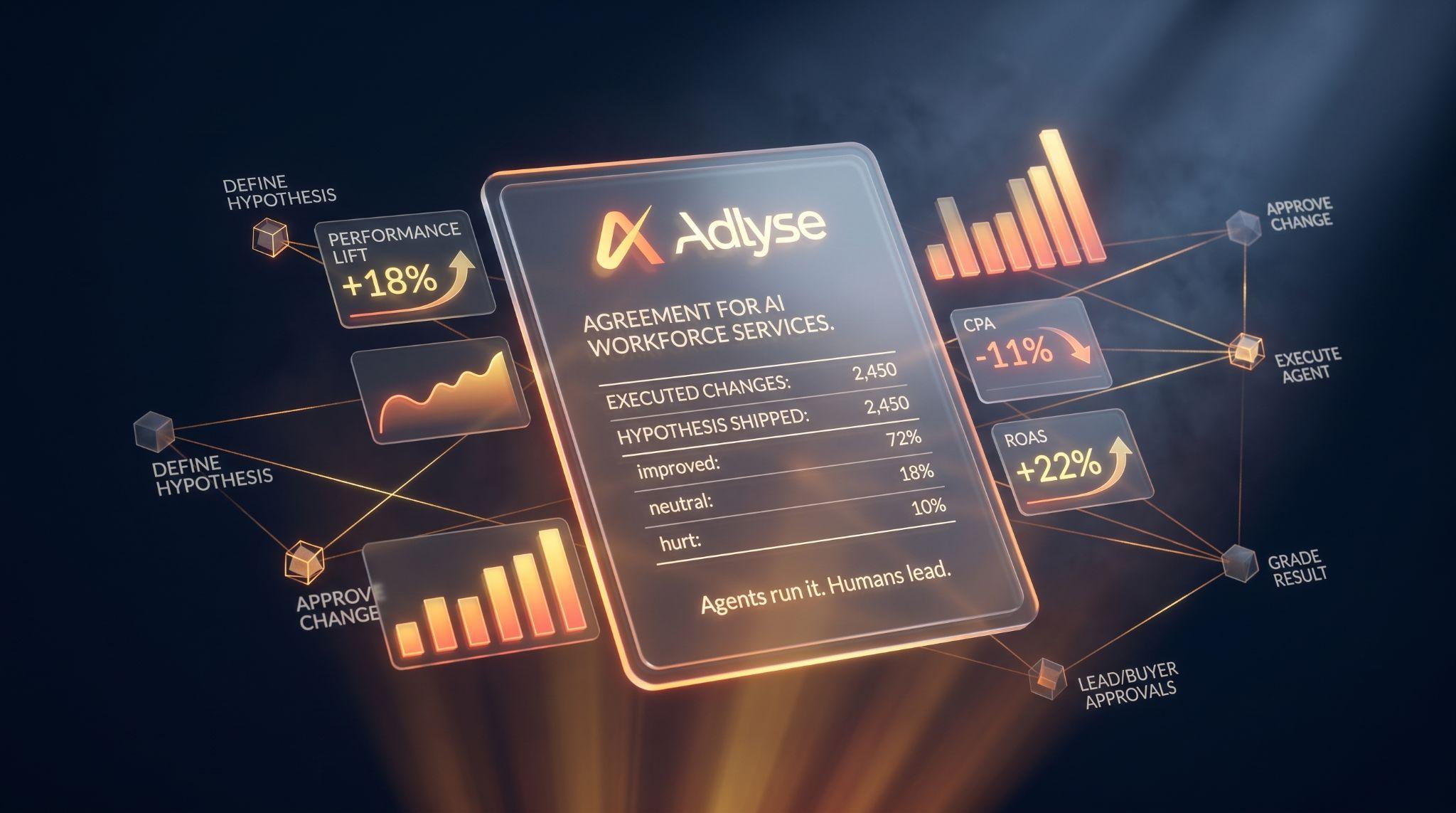
A change-and-verdict record: every change proposed, what it predicted, who approved it, when it executed, and how it graded, improved, hurt, or neutral, with the ones that hurt reverted automatically.
Manual execution never produced this cleanly. Not because agencies were careless, but because the record was a byproduct of work rather than an output of it. Someone had to remember to write down what they changed and why, and then remember, weeks later, to go back and check whether it worked against what they predicted. That last step almost never happened, because there was rarely a written prediction to check against. A monthly report saying "we optimized bids and improved ROAS 8%" is a narrative. A list of eleven changes with eleven predictions and eleven graded outcomes is evidence.
How do you price a record instead of burying it?
Three options, in rough order of how much repricing risk they carry:
- Bundle it into the retainer and name it. Cheapest to implement, and the most common mistake is doing the first half without the second. If it appears in the deliverables list as "monthly change-and-verdict record" rather than silently improving your existing report, the client attaches value to it. Unnamed deliverables become expectations, and expectations are free.
- Price it as a distinct reporting line item. Works best where a client already buys reporting separately or has multiple stakeholders consuming it. It also makes the deliverable portable if you later restructure the engagement.
- Make it the justification for a higher base fee without itemizing it. Reasonable for value-based engagements where itemization invites line-by-line negotiation you'd rather avoid.
The number that matters is one you'll generate, not one you'll read: the count of graded changes in a quarter. Ten changes with ten written predictions and ten verdicts is a defensible quarter of work. "We optimized continuously" is not, at any price.
What this is NOT: the record is not a performance report and shouldn't be sold as one. A graded verdict says whether a specific prediction about a specific change held. Platform-reported performance says what the account did overall. These can point opposite directions in the same month, the account can be up while most individual changes graded neutral, because a seasonal tailwind carried it. A client who is taught to read the verdict record as a performance scorecard will eventually punish you for an honest "hurt" verdict on a month the account grew. Set the distinction on day one.
Which pricing model actually fits?
There's no universally right answer. There is a set of trade-offs worth stating plainly before you pick.
| Model | Works when | Honest downside |
|---|---|---|
| Hourly | Project work, audits, migrations, genuinely variable scope | Directly penalizes efficiency: the better your automation, the smaller the invoice. Also keeps the "how long did that take" conversation permanently available to the client. |
| Flat retainer | Steady scope, ongoing account management, predictable cadence | Scope creep has no natural brake. Clients tend to read a flat fee as unlimited access, and the deliverable list is the only defense. |
| Performance-linked (bonus on a metric) | The metric is clean, attributable, and mostly within your control | You inherit the client's attribution problems. If their tracking is broken or their sales team stops following up on leads, you get paid less for work you did correctly. Cap your exposure and define the metric in writing. |
| Value / outcome-based | You can quantify the business outcome and the client agrees on the baseline | Baseline disputes. Nearly every argument in outcome pricing is about what would have happened anyway, and that argument has no factual resolution. |
| Hybrid (base retainer + performance component, or retainer + priced deliverables) | Most ongoing ad-ops relationships | More complex to sell and administer. If the base is too low it becomes performance pricing with extra steps; if the performance component is small it's theater. |
The hybrid row is where most agencies land, and the reason is structural rather than fashionable: a base retainer prices the work that happens regardless of outcome (strategy, approvals, the record, the relationship), while a performance component prices the part both sides agree is the point. It also survives a bad quarter better than pure performance pricing, which is the model most likely to end an otherwise good relationship.
A specific warning on performance-linked pricing: if you tie your fee to a conversion metric, audit the client's tracking before you sign, not after. A double-firing pixel or an offline conversion import that silently stopped is now your revenue problem. This is the single most common way agencies lose money on a model they chose to make more money.
How do you raise this with a client mid-contract?
Carefully, and not as a pricing conversation.
Lead with the disclosure, separately and earlier. The automation conversation and the pricing conversation should not happen in the same meeting. If they do, the client hears one message: you're using cheaper labor and charging me the same. Disclose the automation on its own, framed around what the client gets, more changes tested, every one recorded and graded, failures reverted automatically. Let that sit for a cycle or two before any commercial discussion.
Bring the record to the disclosure meeting. Don't describe the deliverable. Show a month of it. The difference between "we'll be documenting every change with a prediction and a verdict" and a page showing eleven changes, their predictions, and their graded outcomes is the difference between a promise and an asset.
Reprice at renewal, not mid-term. Mid-term repricing reopens the whole agreement, and you rarely open a contract to change one clause. At renewal you have leverage you don't have in month seven: a completed body of evidence showing what was tested and what worked, which is a far stronger argument than a rate justification. This is the same logic behind how agencies should reprice retainers when agents do the execution.
Change the unit, not just the number. Going from $8,000/month to $10,000/month is a price increase and will be negotiated like one. Going from an hours-based retainer to a scoped engagement with a named deliverable list is a restructure, and it's evaluated on different grounds. The second conversation is the one you want.
The edge case: a client who explicitly bought hours, some procurement-driven and public-sector contracts require an hourly basis, cannot be moved to outcome pricing by persuasion, because the constraint isn't the buyer's preference. Bill hours, and move the value argument to scope and seniority mix instead: fewer hours at a higher blended rate, with the change record as the justification for the rate rather than for a different model.
When should you not change your pricing model?
Repricing is disruptive and sometimes the wrong call. Four situations where the right move is to leave it alone:
- Your margins are already fine. If automation compressed your delivery cost and you're on a flat retainer, you just got a margin increase without touching the invoice. There is nothing to fix. Take the margin, invest some of it in the strategy work that now differentiates you, and revisit in a year.
- The relationship is fragile. A client who is already unhappy about performance will hear any pricing conversation as an agency protecting itself during a bad stretch. Fix the performance first. Repricing during a rough quarter is how you lose accounts you would have kept.
- You can't yet show the new deliverable. Don't sell a change-and-verdict record before you're reliably producing one. The gap between promise and delivery is the most expensive place to be in a repricing conversation, and clients remember it.
- Your automation is thin. If your "AI execution" is a handful of platform-native automated rules, repricing around it will not survive a moderately informed client's questions. Build the capability, then price it. In that order.
FAQ
Related reading
- 2026 Performance Marketing Stack Audit, where a change-and-verdict layer fits in a consolidated agency stack
- How Agencies Should Reprice Retainers When Agents Do the Execution, the retainer-restructuring version of the same pricing conversation
Every change carries a stated hypothesis and a graded verdict, which is what makes the record sellable rather than internal. Start with a free audit.
Start a free audit