TL;DR
OpenAI Ads — sponsored results inside ChatGPT — is now live on Adlyse. That makes five platforms you run from one place: Microsoft, Google, Meta, TikTok, and OpenAI Ads. You can analyze every OpenAI Ads creative and take action right from your ad list, or hand it to the agent. We're in early access and already managing OpenAI Ads for real brands — while CPMs are still low and competition is thin.
Two months after Microsoft Ads went live on Adlyse, we're adding the newest — and frankly the strangest — channel in performance marketing. OpenAI Ads is live on Adlyse today. You can now plan, analyze, and act across five platforms from one place — Microsoft, Google, Meta, TikTok, and OpenAI Ads — and Adlyse treats OpenAI Ads like any other channel in your account: every creative in your ad list, every metric beside it, every action one click, or one message to the agent, away.
What OpenAI Ads actually is
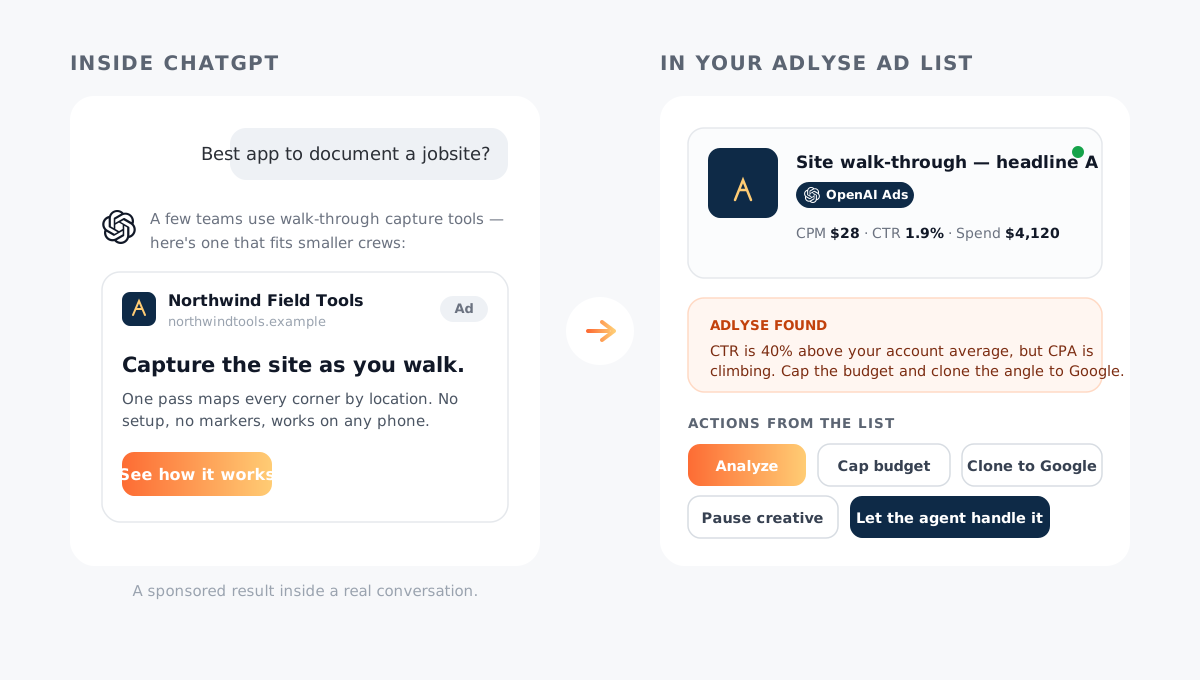
OpenAI Ads are sponsored results that appear inside ChatGPT conversations. When someone asks ChatGPT to recommend a product, a tool, or a place to start, the assistant can surface a labeled, sponsored answer right in the thread — next to the organic response, not bolted onto a separate results page. OpenAI switched this on for its free and logged-in tiers in February 2026 with launch partners like Target, Adobe, Williams-Sonoma, and Albertsons, and opened a self-serve ads platform — with no budget minimum — a few months later. That is what makes it a different kind of advertising: the ad is an answer to a question the user is actively asking, inside a conversation, carrying intent you never get from a feed or a keyword.
The numbers, and why they matter
Early channels are priced like early channels. OpenAI Ads launched at roughly a $60 CPM with a $200,000 minimum spend. Within about ten weeks that CPM had eroded to as low as ~$25, and OpenAI moved toward cost-per-click pricing — bids reported in the $3–$5 range — while CPMs across categories now sit roughly between $25 and $60. The minimum fell from $200K to about $50K, and then the self-serve platform removed minimums altogether. (These figures move fast and vary by category — treat them as an early read, not a rate card.)
Here's why it matters: OpenAI is reportedly targeting around $2.5 billion in ad revenue in 2026, with a stated path toward $100 billion by 2030. Translation — this surface is going to get crowded and more expensive. Right now it is cheap, under-competed, and full of high-intent conversations. That gap between "cheap today" and "expensive soon" is the entire reason to be early.
Here's why it matters: OpenAI is reportedly targeting around $2.5 billion in ad revenue in 2026, with a stated path toward $100 billion by 2030. Translation — this surface is going to get crowded and more expensive. Right now it is cheap, under-competed, and full of high-intent conversations. That gap between "cheap today" and "expensive soon" is the entire reason to be early.
Why it behaves differently from your other channels
A search ad answers a keyword. A social ad interrupts a scroll. An OpenAI ad joins a conversation — so the creative that wins is the one that reads like a genuinely useful next step, not a banner. Placement is contextual and generative rather than slot-based, the user is mid-decision rather than mid-feed, and measurement leans on downstream outcomes instead of impressions alone. It rewards clarity and relevance over spectacle. That is new enough that copying your Meta playbook wholesale will underperform — which is exactly why you want it sitting next to your other channels, judged on the same numbers, from day one.
Analyze and act — straight from your ad list
Inside Adlyse, every OpenAI Ads creative lands in the same ad list as your Google and Meta ads, with CPM, CTR, CPA, and spend right beside it. Adlyse reads it the way it reads the rest of your account: it flags the creative beating your average, the one whose CPA is quietly creeping, and the angle worth cloning to another platform. Then you act without leaving the list — cap a budget, pause a creative, clone a winning angle to Google, or hand the whole thing to the agent. It is the same dollar-first, act-from-the-feed model — including autonomous experiments — that we shipped across the account in July, now extended to a fifth platform. And because OpenAI Ads finally lives in one place with everything else, your cross-platform ROAS counts it too, instead of leaving it in a separate tab nobody reconciles.
Early access, real brands
We're an early-access partner, and we're already running OpenAI Ads for multiple brands inside Adlyse. The platform is young and changing week to week — pricing, formats, and targeting are all still moving — and we'd rather be honest about that than pretend it's a mature channel. That is precisely why it belongs alongside your other platforms rather than in a standalone experiment: so you can test it against everything else you run, on the same dashboard and the same numbers, and move budget the moment the results justify it. If you want OpenAI Ads on your account, or you're still weighing where AI advertising is headed, we'll get you set up.
Want OpenAI Ads managed alongside Microsoft, Google, Meta, and TikTok?
Try Adlyse free