
Adobe forecasts $47.5 billion in US online sales for Cyber Week 2026, up 7.4% on last year. Cyber Week runs from Thanksgiving, November 26, to Cyber Monday, November 30. Adobe expects Cyber Monday to be the biggest single day at $15.1 billion, and Black Friday to grow fastest at 9.2% (Adobe, September 28, 2026). The calendar matters more than usual this year, because Cyber Monday has moved into November.
What does Adobe forecast for Cyber Week 2026?
Adobe's release forecasts $275.1 billion in US online holiday sales for November 1 to December 31, up 6.7%. Within that, per Adobe's release:
- Cyber Week (Nov 26 to 30): $47.5 billion, up 7.4%, about 17.3% of the season. Adobe defines it as the five days between Thanksgiving and Cyber Monday.
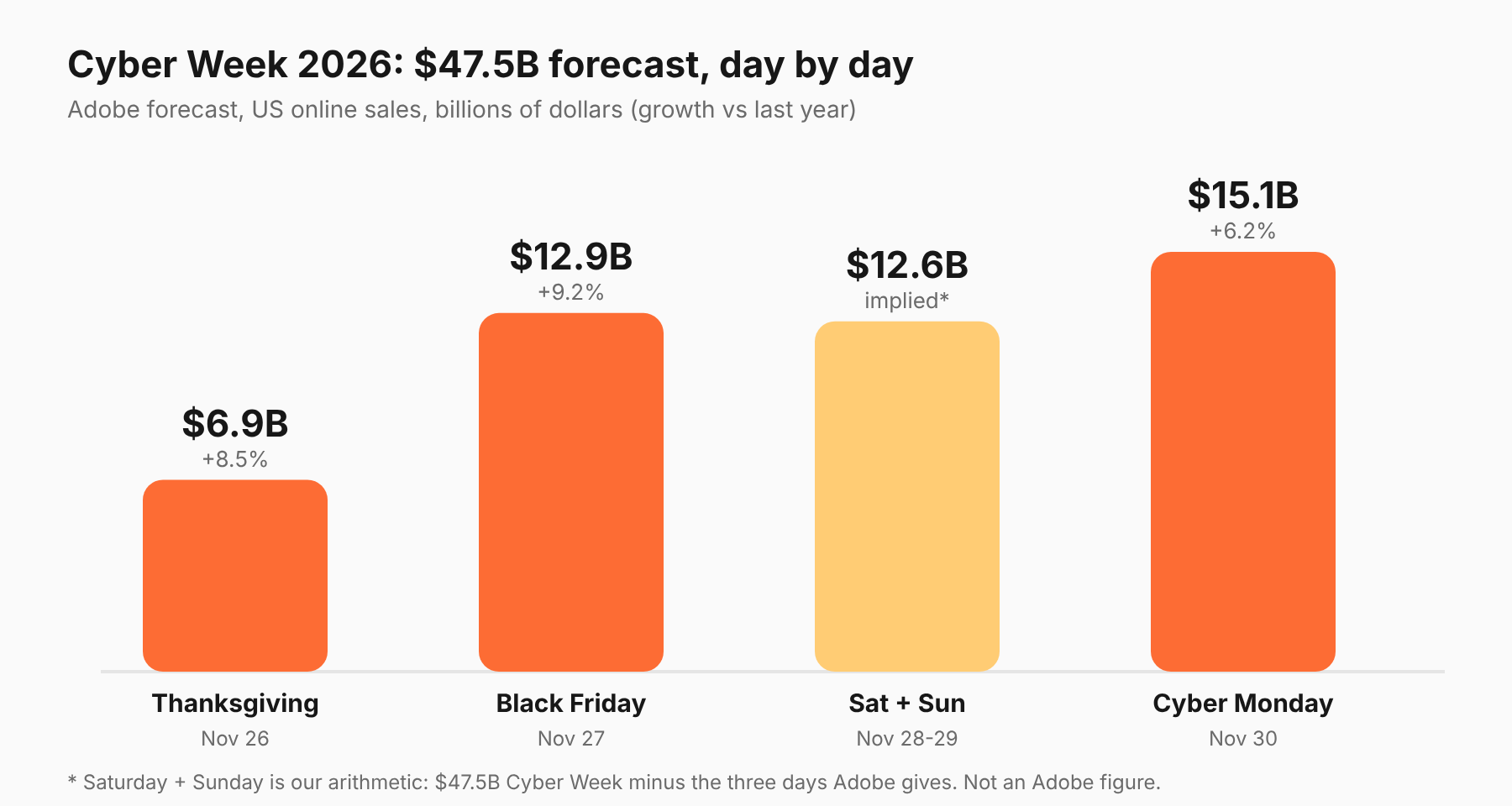
- Thanksgiving (Nov 26): $6.9 billion, up 8.5%.
- Black Friday (Nov 27): $12.9 billion, up 9.2%, the fastest growth of the key days.
- Cyber Monday (Nov 30): $15.1 billion, up 6.2%, the biggest single day of the season.
These are forecasts for US online retail, not measured results. Adobe's analysis covers retail sites on its platform, per its forecast document.
Why does the calendar shift matter for your budget?
Cyber Monday moved from December 1 last year to November 30 this year. Adobe's forecast document says this pushes spend into November. It forecasts November at $145.1 billion, up 17.8%, and December down 3.5%, and it attributes much of the swing to the calendar.
Our arithmetic backs that up. Adobe's $275.1 billion season minus its $145.1 billion November leaves about $130 billion for December. Working back from Adobe's growth rates, last year's November was roughly $123 billion and December roughly $135 billion.
The takeaway is practical. Do not read "November is up 17.8%" as a surge in demand. Much of it is one big day changing months. If you pace budget off last year's monthly totals, you may under-fund November and over-fund December. Compare event days to event days instead: Thanksgiving to Thanksgiving, Cyber Monday to Cyber Monday.
Which days will carry the most spend?
Adobe gives three days. Add them up and they come to $34.9 billion, which leaves $12.6 billion of the $47.5 billion for Saturday and Sunday, November 28 and 29. That is our arithmetic, not an Adobe figure. It works out to about $6.3 billion a day, close to Thanksgiving, and the two days together nearly match Black Friday.
So the weekend is not a lull. If your plan has a pause or a cut between Friday and Monday, check it against that number first.
Adobe also says Cyber Monday will be the first single online shopping day to exceed $15 billion, per its forecast document.
When do discounts peak?
Late in Cyber Week. Adobe expects average discounts to build through the season, per its release:
- Early November: up to 14%.
- Just before Thanksgiving: up to 21%.
- Cyber Week: up to 30%.
- December: 10% to 15%.
The release says "up to" for each figure. An independent write-up of the release, by PPC Land, notes that Adobe's discount chart does not fully support the December range. Treat December as a rough guide.
For ads, the point is the order of events. Shoppers meet deeper discounts in the days when your competitors are bidding hardest. A promotion that looks strong on November 10 may look ordinary on November 28.
What do the mobile and AI traffic numbers change?
Mobile first. Adobe forecasts mobile at 57.4% of November and December online transactions, up from 56.4%, and 63% of Thanksgiving sales, per its forecast document. If your landing pages or checkout are slow on a phone, Thanksgiving is the day it costs you most.
Adobe also forecasts AI-referred traffic to retail sites up 130% over the season, with Thanksgiving up 159%, Black Friday up 95% and Cyber Monday up 88%, per its release. Adobe does not state the starting level. A large percentage on a small base can still be small. In its forecast document, Adobe also reports that in August 2026, AI-referred visitors converted 48% higher than non-AI traffic. Adobe does not define "AI traffic" in that document, so do not copy the figure into a client plan without checking your own analytics.
How should you pace budgets around the forecast?
This section is our opinion, built on Adobe's numbers.
Pace by event day, not by month. Set daily budget curves for November 26 to 30 from last year's event days, not last year's month totals. The calendar shift breaks month-over-month comparisons.
Do not cut the weekend by default. Saturday and Sunday together look like Black Friday in size. Decide on purpose, using your own conversion data, whether to hold or trim them.
Keep room for Cyber Monday. It is the biggest single day. Do not burn your remaining budget by Sunday night. Write the Monday ceiling down in advance.
Plan for mobile. Check your mobile page speed and checkout before Thanksgiving, not during it.
Freeze structure, not budgets. Late structural changes force platforms to re-learn when you can least afford it. Budget moves are a different matter, and the pacing plan below covers them.
For the full pacing approach, read Q4 and BFCM pacing with agents and set up the weekly operating routine before the week starts. Platform-reported results will be noisy that week, so read them with our guide to why ROAS misleads across platforms.
What are the limits of this forecast?
Four limits, all worth saying out loud to a client:
- It is US online retail only. It will not describe B2B, services or other countries.
- It is a forecast. Adobe publishes actuals after the event.
- It is an average. Your category, price point and audience can behave differently.
- Adobe sells analytics products. That does not make the numbers wrong. Cross-check them with another forecast. For example, Deloitte forecasts US e-commerce of $316.1 billion to $318.9 billion for November 2026 to January 2027, a different period and scope, so the two figures do not compare directly.
Adobe's release does not discuss inflation, tariffs or consumer finances.
What should you do next?
Write your Cyber Week plan day by day this week: a budget, a target and a stop rule for each of the five days. If you run changes through Adlyse, each approved change ships with a hypothesis and is graded improved, hurt or neutral afterward. A plan that names what each day should do is easy to grade on Tuesday, December 1.