
Meta does not sell one product called a "Meta Ads agent." People searching for one usually mean one of two real things. Meta Business Agent answers your customers in chats. It does not buy ads. The Meta AI business assistant advises on ads, and Meta's Advertising Week post of October 6, 2026 adds agentic actions to it, such as changing a budget by conversation. Per the coverage we could read, those actions and scheduled tasks are in testing, not generally available.
Is there a product called "Meta Ads agent"?
Not as a named Meta product, as far as the pages we reviewed show. The phrase is a search habit. It covers anything from "an AI that talks to my leads" to "an AI that runs my campaigns."
Those are different jobs, and Meta has built different tools for them. The customer-conversation tool is Meta Business Agent. The advertiser-facing helper is the Meta AI business assistant. A third layer, third-party agents that act in your ad account, sits outside Meta's own products. Mixing them up is how teams buy the wrong thing or switch on the wrong one.
What does Meta Business Agent do?
It is a customer-facing agent. Meta announced it on June 3, 2026 and says it answers business-specific questions, recommends products from your catalog, books appointments, qualifies leads, closes sales, and lets you decide when a team member steps in.
Meta's product page says it works across Messenger, WhatsApp, and ads you create. That last part causes confusion. The agent talks to people who arrive from your ads. It does not create, budget, or optimize those ads.
Availability, as Meta words it:
- The product page says it is available to eligible businesses in select markets, with more markets launching soon.
- The announcement says getting started is free and that in the coming months businesses will access the agent through Meta's paid subscription offerings.
- Setup in the WhatsApp Business app needs a phone number already registered there. Our Meta Business Agent complete guide covers the controls.
What is the Meta AI business assistant?
It is the advertiser-side helper. Meta's Advertising Week post is the source. Per Marketing Dive's report, Meta is expanding its AI business assistant, which gives conversational guidance on ad creation, with creative insights and more memory and context. Meta described that context as "what you tried last quarter, your seasonality, and the goals you've described."
Relevant Audience's summary of the post also lists Meta testing the import of strategy, voice, and brand guidelines from other AI tools. Meta also says assistant adopters are "typically seeing 5% more conversions at the same cost per conversion," per that summary. The source does not publish the method, comparison group, period, or verticals, so treat it as a platform claim, not a benchmark.
What can the business assistant do to a campaign?
This is where "in testing" matters. The reporting on Meta's October 6 post describes two new capabilities:
- Conversational campaign actions. The assistant would plan and create campaigns, generate creative, update targeting, and change budgets through conversation. Relevant Audience quotes the post as "Agentic actions, beginning to be tested," and says Meta expects marketers to do this "soon." MediaPost also describes these as agentic capabilities Meta is testing. Social Media Today gives no availability status.
- Scheduled tasks and alerts. Recurring work such as performance monitoring, weekly summaries, and reminders to review budgets. Relevant Audience quotes the post as "in testing."
Meta's post also describes previews and approvals around these actions, per the same summary. We could not read Meta's page directly (see open items), so verify the wording there before you rely on it.
Meta's Ads Creative Studio is the one clear rollout. Per Relevant Audience's summary, it was previously limited to selected partners and is beginning to roll out to more advertisers.
How do the three compare?
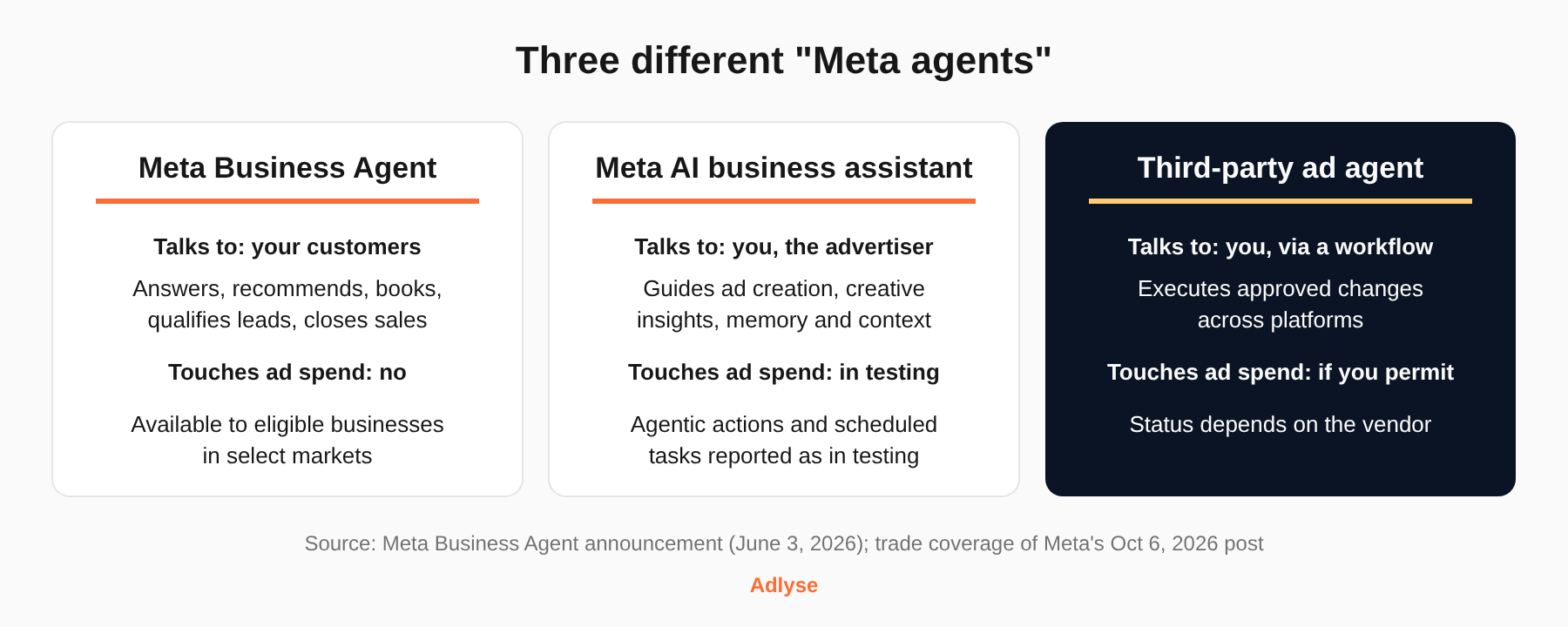
| Meta Business Agent | Meta AI business assistant | Third-party ad agent | |
|---|---|---|---|
| Who it talks to | Your customers | You, the advertiser | You, via a workflow |
| Main job | Answer, recommend, book, qualify, close | Guide ad creation; creative insights | Execute approved changes across accounts |
| Touches ad spend? | No | Conversational budget and targeting changes are in testing | Yes, if you permit it |
| Status per Meta's wording | Available to eligible businesses in select markets | Expanding; agentic actions and scheduled tasks in testing | Depends on the vendor |
| Where it lives | WhatsApp, Messenger, ads you create | Meta's ad tools | Outside Meta |
Which one do you actually need?
Start from the job, not the name.
- Leads go cold in the inbox after click-to-message ads. Look at Meta Business Agent.
- Your team loses time on creative ideas and campaign setup inside Meta. Look at the business assistant, and test any action feature on a small account first.
- You run Meta alongside Google, Microsoft, and ChatGPT Ads. A Meta-only assistant cannot see the others. That is a third-party agent problem.
Whatever you pick, ask the same questions. What can it change? Who approves? Where is the log? Our guide on how to evaluate agentic AI marketing tools lists them, and the autonomy guardrails post covers limits worth setting before an agent touches budgets.
What about pricing and Meta One?
Meta has said Business Agent moves to paid subscription access in the coming months. We did not find pricing for the new assistant features in the sources we read. For how Meta's subscription tiers gate AI features, see what Meta One's tiers actually gate. For the wider map of Meta and agents, see the Meta Ads and AI agents guide.
What should you do next?
If you want an agent on the ad side across platforms, Adlyse executes approved changes across Google, Meta, Microsoft, and ChatGPT Ads, ships each with a hypothesis, and grades the result as improved, hurt, or neutral.