
An AI agent for Meta ads should not change spend unless a named person has approved either that change or the standing rule that triggers it. That is an approval gate. Without one, you are trusting the agent's judgment on your budget with no way to ask afterward who decided what. Below are seven requirements you can put to any vendor, and a simple way to test each one in a demo.
What is an approval gate?
An approval gate is a step where a change to your account is held until a person says yes. The agent proposes. A human decides. Only then does anything execute. The decision can be about one change, or about a standing rule that covers many future changes.
Three things separate a real gate from a marketing phrase:
- It blocks execution. The change cannot run until someone approves it or an approved standing rule covers it.
- It names the approver. You can see who approved, and when.
- It covers everything that spends or targets. Budgets, bids, audiences, creative swaps and pauses, not only "big" changes.
"Human in the loop" can mean any of these, or just a dashboard you can look at after the fact. Ask which one you are buying.
Why do approval gates matter more on Meta?
Meta's delivery system already makes many decisions for you. An agent on top adds a second decision-maker. When results move, you need to know whether Meta's system or your agent caused it. A gate gives you a dated record of every change the agent made, so you can separate the two.
There is also a plain accountability point. Someone at your company, or your client, will ask who changed the budget. "The agent did" is not an answer a finance lead accepts.
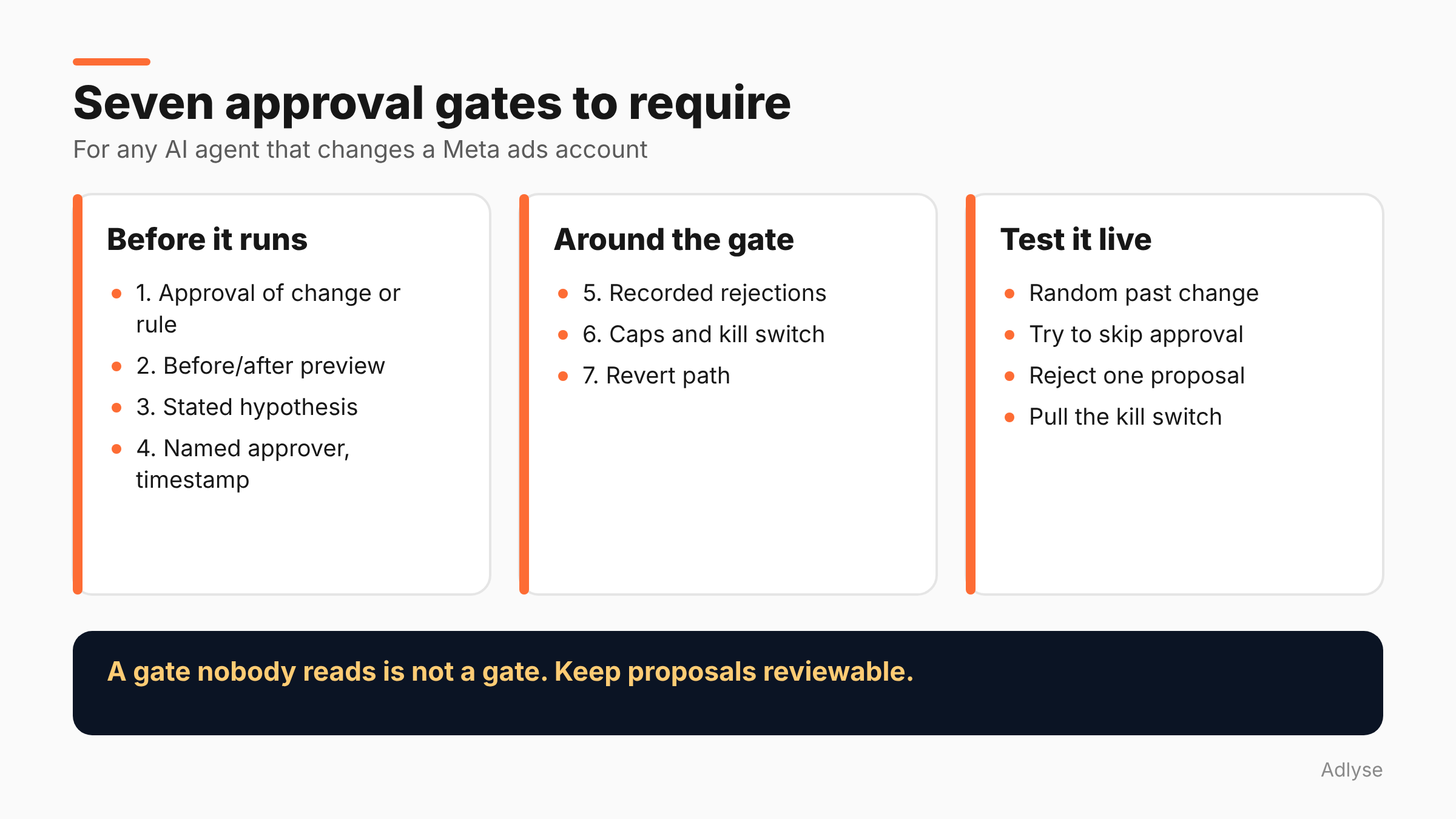
What should you require? Seven checks
- Every executing change traces to an approval. Ask: "For any change that ran, can you show me the person who approved it, or the rule they approved?" If a change ran on neither, you have no gate.
- A before/after preview. The approver should see what the setting is now and what it will be. A sentence like "increase budget" is not a preview.
- A stated reason. Each proposal should carry a hypothesis: what the agent expects to happen, and how it will be judged. Without it, the approver is signing blind.
- A named approver and a timestamp. Ask to see one past change with who approved it and when.
- A reject path that is recorded. Rejections teach you what the agent gets wrong. Ask whether rejected proposals are kept.
- Hard limits that sit outside the gate. Budget caps, a spend record and a kill switch should apply even to approved changes. Ask who can trigger the kill switch and how fast it takes effect.
- A revert path. If an approved change goes badly, how does it get undone, and is that automatic or manual?
How do you test these in a demo?
Do not accept slides. Use a live or recorded account:
- Ask the vendor to pick a change at random from last month and show the full record: preview, hypothesis, approver, time, outcome.
- Ask them to try to execute a change that no approval or approved rule covers. It should fail.
- Ask them to reject a proposal and show where that is recorded.
- Ask them to trigger the kill switch and show what stops.
- Ask what a bad result looks like and what the system does next.
Five minutes of this tells you more than a feature list.
What does the platform itself log?
Do not rely on the agent's own record alone. Ask what the ad platform keeps. Google's help page on change history says Google Ads covers the past two years, that changes through the API by a third-party tool can appear under the tool's name, and that not every change is necessarily listed. That is a useful model for the question to ask about Meta: what does Meta's own history show for changes made by a connected tool, and for how long?
We have not verified Meta's equivalent retention or labeling. Check it in your account before you rely on it.
How does this relate to regulation?
The EU AI Act sets human-oversight rules for systems it classifies as high-risk. Article 14 says people overseeing such systems should be able to "disregard, override or reverse the output," and be aware of "automation bias," the tendency to over-rely on the output. Ad management tools are not automatically high-risk under the Act, so this is not a compliance claim. It is a useful vocabulary: can a person override the agent, and are they tempted to approve everything without looking?
That second point is real for approval gates. A gate that someone clicks through 200 times a day protects nothing. Keep proposals reviewable in size and volume.
What about standing rules that run without a click?
A standing rule is an approval given in advance. A person decides once that when a condition is met, a change may run without asking again. A common example: if a creative has spent over $50 with no conversions, pause it. The gate moved from the change to the rule.
That is a sensible way to cut the review queue, but the rule now needs the scrutiny the change would have had. Require these:
- A precise condition and action. Spend threshold, window and what happens, with no vague "if it looks bad."
- A named approver and a date for the rule itself.
- A limit on reach. Which campaigns or accounts the rule covers.
- A log of every time it fires, with the same fields as any other change.
- A way to review, pause or delete the rule, and a kill switch that overrides it.
- A look at the numbers. A $50 threshold that suits one account may be too low or too high for another. Check it against your own cost per conversion.
What does an approval gate cost you?
Speed and attention. Per-change approval means each change waits for a person. If your approver is on holiday, nothing ships. Set a backup approver and a review window, and consider standing rules for the low-stakes, repetitive cases.
For some teams, that is the wrong trade. Teams that want software to act in minutes and are comfortable with preset limits may prefer a different model. For the control-versus-speed argument in full, see AI Autonomy in Ad Spend.
What does Adlyse do?
Adlyse executes approved changes on six platforms: Google Ads, Meta, Microsoft Ads, TikTok, AppLovin and OpenAI's ChatGPT Ads. A change runs after a person approves it, or automatically under a rule a person approved in advance, for example: pause any creative that has spent over $50 with no conversions. Changes Adlyse proposes ship with a before/after preview and a hypothesis, and results are graded improved, hurt or neutral. A change graded hurt is reverted automatically. Budget caps, a spend ledger and a kill switch are configured first. For what a complete record should contain, see An Audit Trail for AI-Driven Ad Spend.
For the wider picture of agents on Meta, read the Meta Ads AI agents guide. To score the rest of the vendor's controls, use How to Evaluate Agentic AI Marketing Tools.
Ready to see Adlyse on your accounts?
Book a walkthrough and we run it against a live account, so you see the workflows, the approvals, and the reporting for yourself.
Request access