
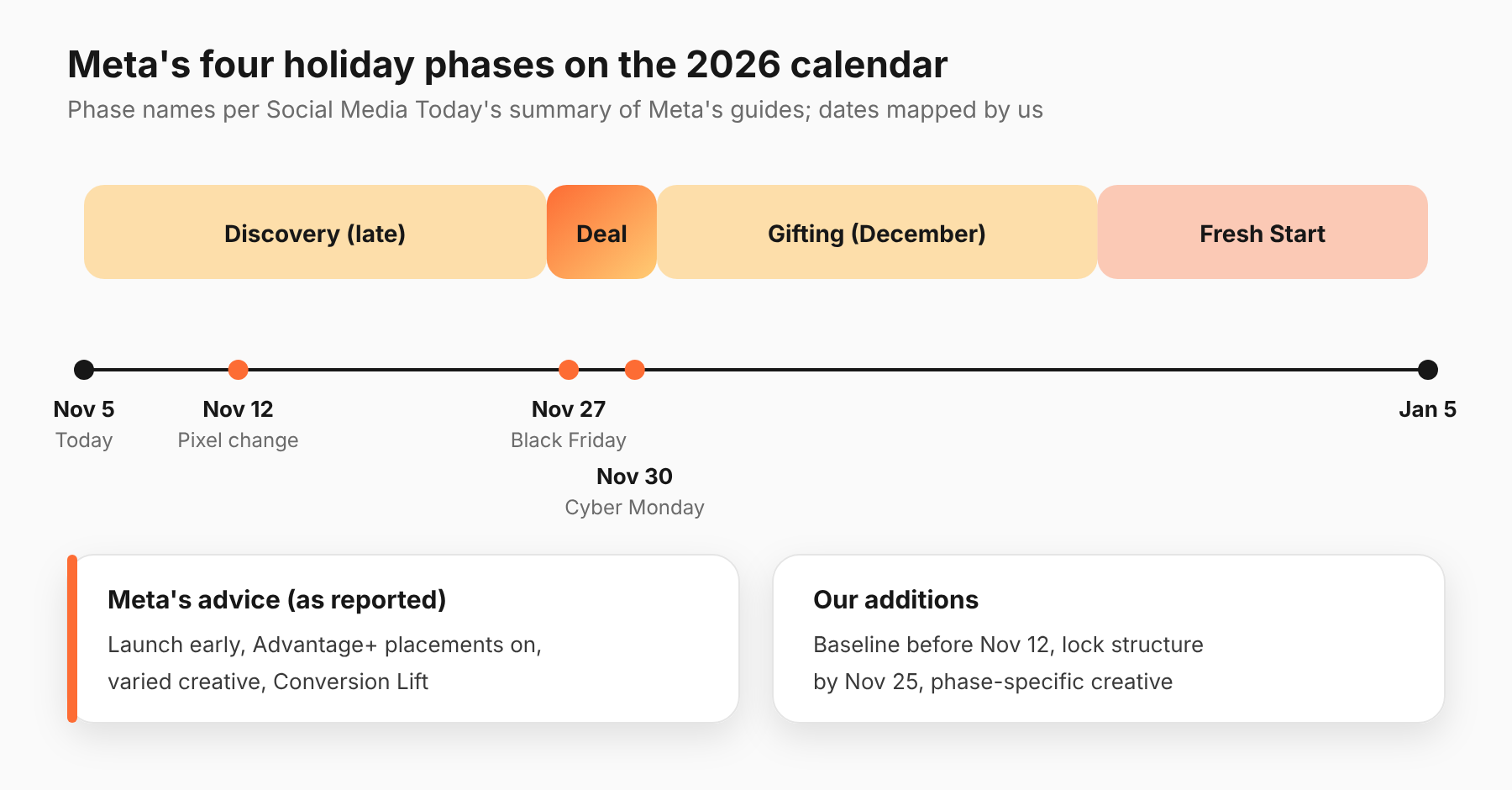
Meta's holiday guidance splits the season into four phases: Discovery, Deal, Gifting and Fresh Start. Today, November 5, 2026, you are late in Discovery. Deal starts with Black Friday on November 27. This post maps Meta's phases to a dated calendar for the next eight weeks and marks what is Meta's advice and what is ours.
What are Meta's four holiday phases?
According to Social Media Today's summary of Meta's holiday guides, the phases are:
- Discovery: October to early November.
- Deal: Black Friday and Cyber Monday.
- Gifting: throughout December.
- Fresh Start: late December into the new year.
Relevant Audience reported the same four phases on August 13, 2026. Meta's own pages are listed as creative approach, Advantage+ strategy and measurement. We could not open those pages, so the advice below is as Social Media Today and Relevant Audience report it.
What does Meta tell advertisers to do?
Per Social Media Today's summary, Meta's recommendations are:
- Start campaigns as early as possible, so the learning phase can begin and Meta's systems can learn how audiences respond to promotions.
- Use Advantage+ campaigns, which spread ads to potential buyers from October through December.
- Turn on Advantage+ placements as soon as possible, so campaigns run at peak efficiency by Black Friday.
- Provide multiple creative formats, so Advantage+ can match the right creative to each person.
- Use Conversion Lift analysis to measure the path to purchase and attribute sales accurately.
Relevant Audience adds that a November launch means paying peak auction prices while the system is still learning. That is its reading of Meta's advice, not a Meta statement.
Note what is missing. The sources we read do not give a learning-phase length, an ad-review deadline or a budget level. Don't invent them.
How do the phases map to the 2026 calendar?
This is our plan, built on Meta's phase names and the real dates.
Nov 5 to 11: late Discovery.
Meta's advice is to be live already. If you are not, the cost of waiting rises every day. Do not launch a large structural change now. Instead, check creative variety, placements and tracking. Save your Meta-to-backend conversion ratio as a baseline, because of a measurement change on November 12 (below).
Nov 12 to 18: the measurement change.
Per PPC Land, Meta Pixel turns on "Measure conversions on customer devices" by default from November 12, outside the EU and UK. Reported conversions may rise with no change in performance. Compare against backend orders, not against last week's Meta numbers.
Nov 19 to 25: last week before Deal.
Lock structure. Check ad approvals and stock. Confirm offers match your landing pages. Decide the budget plan for each of the four Deal days.
Nov 26 to 30: Deal.
Thanksgiving is November 26, Black Friday is November 27 and Cyber Monday is November 30. Meta's guidance is about Advantage+ and creative variety. Our advice is operational: monitor conversions against orders, watch stock and keep a person on call.
Dec 1 to about Dec 20: Gifting.
Offers change. Adobe expects December discounts to ease to roughly 10% to 15%, per its forecast document. Refresh creative from "deal" to "gift" language and check delivery dates. We have no source for shipping cutoffs, so confirm them with your carriers.
Late Dec to January: Fresh Start.
Meta groups late December into the new year as its own phase. Plan creative and offers for people who are not buying gifts, and review what the season taught you.
How should you use Advantage+ across the phases?
Meta's advice, as reported, is to use Advantage+ campaigns across October to December and to turn on Advantage+ placements early. Two practical notes, which are ours:
Creative drives targeting. In Advantage+ campaigns, the creative does more of the audience work. Copy aimed at new customers and copy aimed at returning customers will pull different people. Match the message to the goal.
Give it variety, not volume. Meta's guidance is multiple creative formats, not hundreds of assets. A few clear, distinct ads that you can name and judge beat a large pile.
For a full guide to the Meta side of automation, see Meta Ads and AI agents: the complete guide.
How should creative change by phase?
This section is our opinion, built on Meta's advice to provide multiple creative formats.
Discovery: lead with the product and the reason to choose it. People are researching, so show what it does and what makes it different.
Deal: lead with the offer and the deadline. State the price or discount clearly and match it exactly to the landing page. A mismatch costs trust and approvals.
Gifting: lead with who it is for and when it arrives. Gift language, delivery dates and easy returns carry more weight than discount depth.
Fresh Start: lead with new routines, self-purchase and replacement. The buyer is now shopping for themselves.
Keep a short list of creative you can swap in on a given day, so a phase change is a swap and not a rebuild. Label each ad by phase in its name, so you can see which ones were live when you read the results.
How should you measure the season?
Meta recommends Conversion Lift, per the summary. We agree that platform-reported conversions are not enough on their own on peak days. A lift study compares exposed and unexposed groups. It can tell you whether Meta caused sales, not just whether it was present for them.
You may not have time to set one up before Black Friday. If not, use a simpler holdout, such as a region or campaign set with lower spend, and read the result against backend orders. Our incrementality testing guide explains the options, and our post on reading cross-platform numbers covers the pitfalls.
What do the sources not tell us?
- Meta's own pages. We could not open them. The summary is second-hand.
- Timing rules. No learning-phase length or review deadline appeared in the sources we read.
- Region differences. Relevant Audience points out that markets with different peak dates, such as 11.11 and 12.12 in Thailand, may need earlier phases. That is its analysis, not Meta's.
What should you do next?
Write one line for each phase: the goal, the budget and the stop rule. If you run changes through Adlyse, each approved change ships with a hypothesis and is graded improved, hurt or neutral. Phase goals are hypotheses. Write them down now so you can grade them in January.