AI Adoption in Marketing Is Accelerating, But Most Teams Are Using It Wrong
Higher ROAS. 10x less work.
Put Adlyse on your accounts. Daily audits, agentic optimization, and reports your clients actually read.
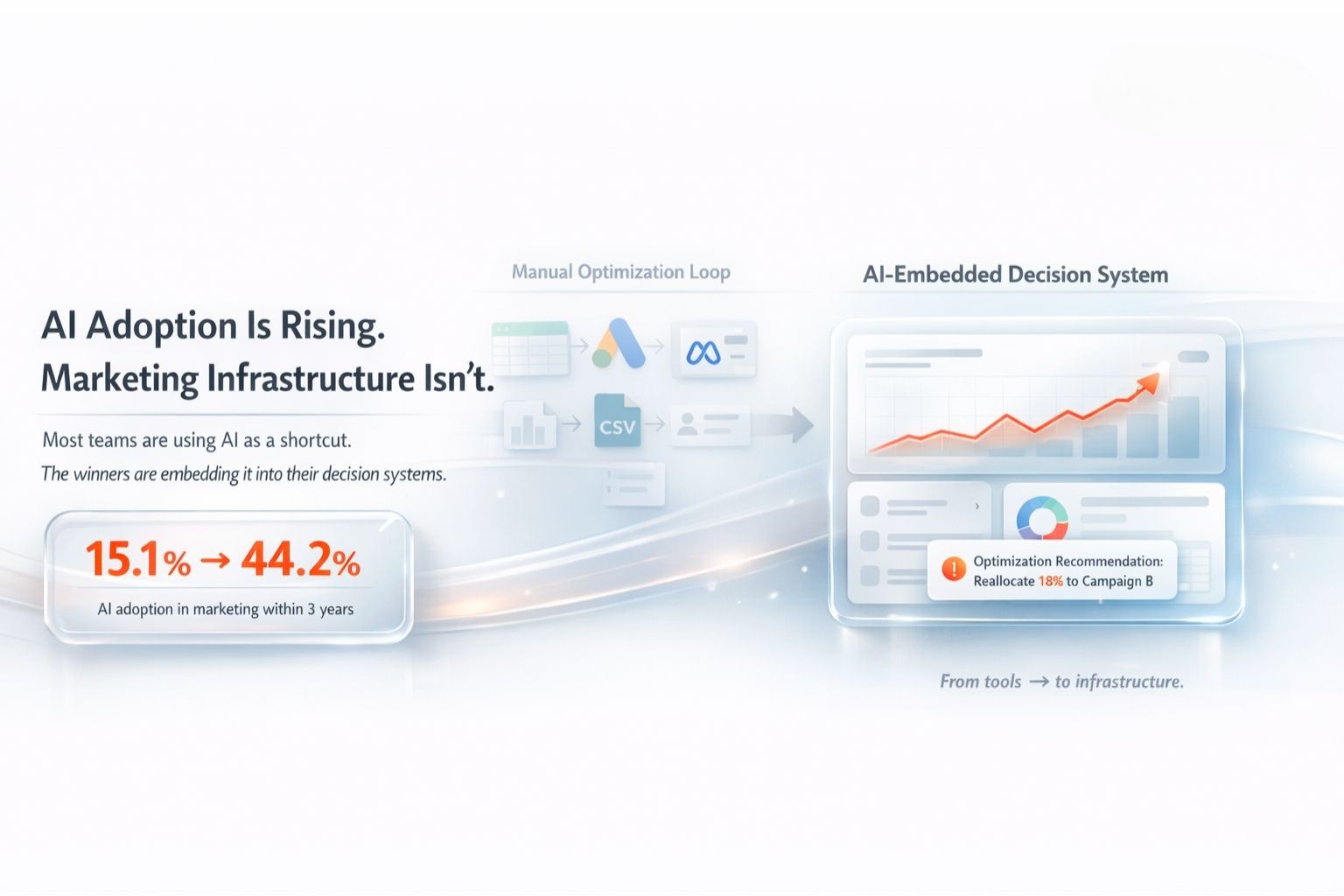
Request a demoAI adoption in marketing teams has reached 15.1% and is projected to hit 44.2% within three years.
That's not incremental growth.
That's a structural shift.
But here's the uncomfortable truth:
"Most companies are still using AI as a tactical shortcut, not as marketing infrastructure."
They're experimenting with AI tools.
They're not rebuilding how marketing decisions get made.
And that distinction is going to define who scales, and who stalls, over the next 24 months.
The Old Model: Manual Optimization Doesn't Scale
Traditional performance marketing looks like this:
- Pull reports manually from Google, Meta, TikTok
- Export data into spreadsheets
- Debate attribution and performance signals
- Make incremental budget shifts
- Repeat weekly
This worked when:
- Channels were limited
- CAC was predictable
- Creative fatigue was slower
- Teams had fewer campaigns to manage
That world no longer exists.
Now:
- Multi-channel spend is standard
- Creative testing cycles are faster
- Acquisition costs are rising
- Performance volatility is constant
The Core Problem
The Real Shift: From AI Tools to AI Systems
Most marketing teams are asking:
"How can we use AI to help us create faster?"
The better question is:
"How can AI restructure how we analyze, optimize, and scale?"
There's a fundamental difference between using AI for tasks and embedding AI into your marketing decision system.
Tactical AI Usage (Low Leverage)
- Generating ad copy
- Summarizing performance reports
- Brainstorming creative angles
- Writing campaign descriptions
Useful? Yes.
Transformational? No.
System-Level AI (High Leverage)
- Automated account + website research
- Cross-channel performance analysis
- AI-generated optimization recommendations
- Context-aware reporting
- Continuous learning from past decisions
This is infrastructure.
And infrastructure compounds.
Why Companies Without Structured Marketing Systems Are at Risk
AI amplifies systems.
It does not fix chaos.
If your marketing team:
- Pulls reports manually
- Has fragmented data across platforms
- Struggles to explain what's driving ROI
- Can't clearly identify top-performing campaigns
- Operates without a centralized performance intelligence layer
Then AI tools won't solve your scaling problem.
They'll just accelerate confusion.
What's Missing
What Modern Marketing Infrastructure Looks Like
The teams winning in 2026 won't just run ads.
They'll operate self-optimizing marketing systems.
Here's what that includes:
1️⃣ Automated Research as a Baseline
Instead of onboarding analysts to understand a new account, AI systems automatically:
- Analyze Google Ads data
- Extract insights from website content
- Compare positioning against competitors
- Identify performance factors impacting ROI
This eliminates hours of manual review and shortens the time-to-insight.
2️⃣ AI-Powered Strategic Insights
Reporting data isn't enough.
Modern systems must:
- Highlight underperforming campaigns
- Suggest budget reallocations
- Identify structural weaknesses
- Recommend scalable opportunities
The goal isn't more data.
It's faster, clearer decisions.
3️⃣ On-Demand Reporting Without Bottlenecks
Manual reporting creates lag.
AI systems allow teams to:
- Ask plain-language questions
- Generate instant reports
- Download performance breakdowns
- Analyze time-bound metrics immediately
This removes analyst dependency and improves decision velocity.
4️⃣ Contextual Memory & Continuous Learning
Most tools forget.
AI marketing systems remember.
They store:
- Business context
- Performance history
- Past optimizations
- Strategic preferences
This enables smarter, increasingly personalized recommendations over time.
That's how predictability improves.
The Strategic Advantage: Scale Without Scaling Headcount
For agencies, this means:
- Higher revenue per employee
- Ability to manage more accounts
- Less manual performance analysis
- Faster client reporting
For brands, it means:
- Improved ROAS clarity
- Reduced wasted spend
- More confident scaling decisions
- Stronger cross-channel performance visibility
The outcome is the same:
More control.
More predictability.
More scalability.
Without proportional team growth.
AI Adoption Is Rising, But Infrastructure Wins
AI adoption isn't increasing because it's trendy.
It's increasing because manual marketing operations don't scale anymore.
The companies that win won't be the ones experimenting with AI tools.
They'll be the ones embedding AI into:
- Decision-making workflows
- Reporting systems
- Optimization cycles
- Cross-channel performance analysis
"That's the difference between using AI and building with AI."
Where Adlyse Fits
Adlyse was built around a simple principle:
Marketing teams don't need more dashboards.
They need an AI worker embedded into their performance system.
Adlyse:
- Automatically researches your account and website
- Analyzes performance across platforms
- Provides AI-powered optimization insights
- Generates instant reports
- Maintains contextual memory for smarter recommendations
It's not a creative assistant.
It's a marketing intelligence layer.
The Goal
The Real Question for 2026
It's not:
"Are you using AI?"
It's:
"Is AI embedded into how your marketing decisions are made?"
If your team is scaling spend but still operating on manual workflows, the gap will widen quickly.
The future of marketing isn't more effort.
It's better infrastructure.
See how Adlyse analyzes your account and identifies what's working, instantly.
Ready to Build Your Marketing Infrastructure?
See how Adlyse embeds AI into your performance system for smarter decisions at scale.