AI Adoption in Marketing: From Experimentation to Infrastructure (2024–2026)
Higher ROAS. 10x less work.
Put Adlyse on your accounts. Daily audits, agentic optimization, and reports your clients actually read.
Request a demoIn 2024, AI was something marketing teams experimented with.
By 2025, it became something they used daily.
By 2026, it's becoming the infrastructure they build on.
This shift isn't incremental. It's structural.
Recent data shows:
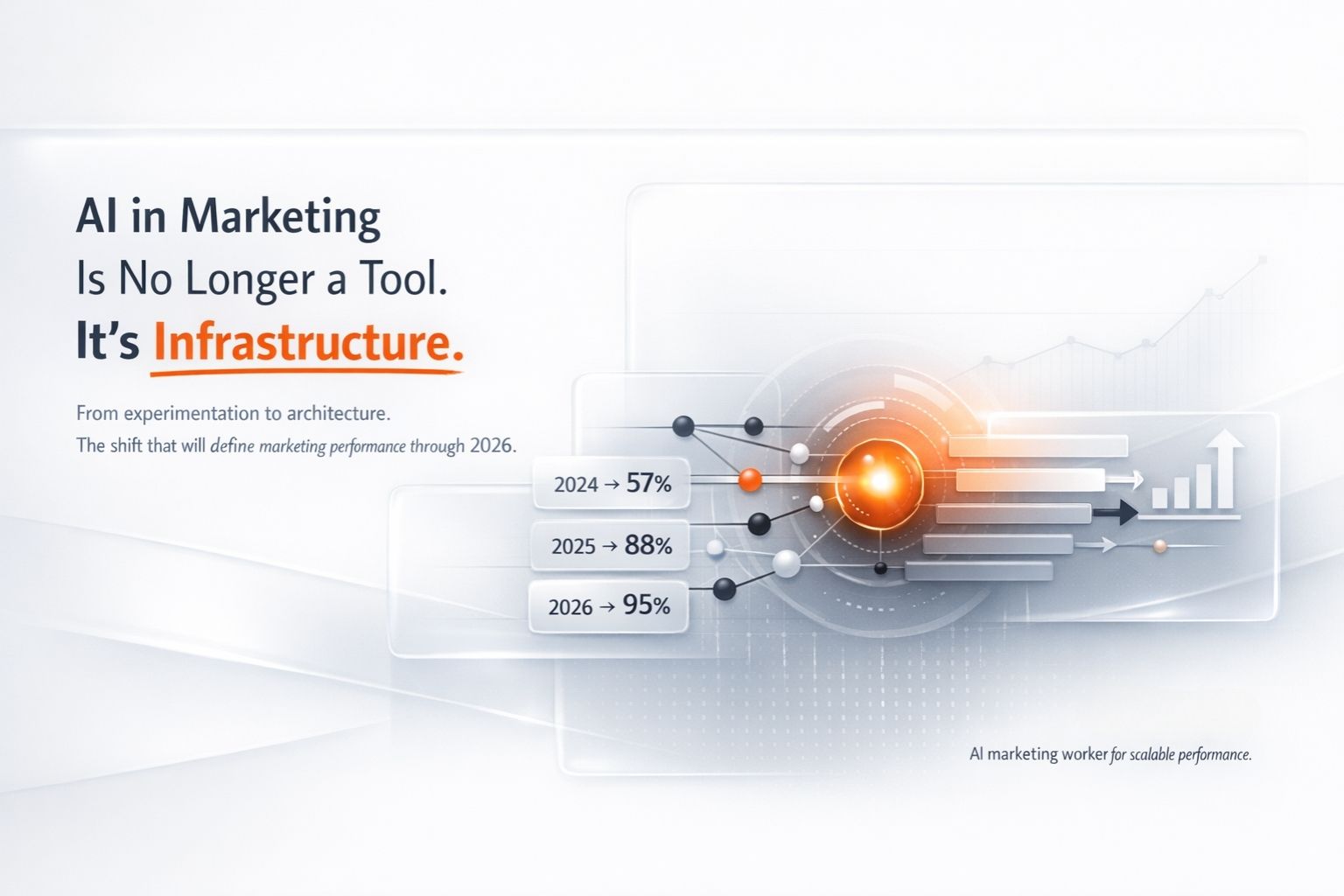
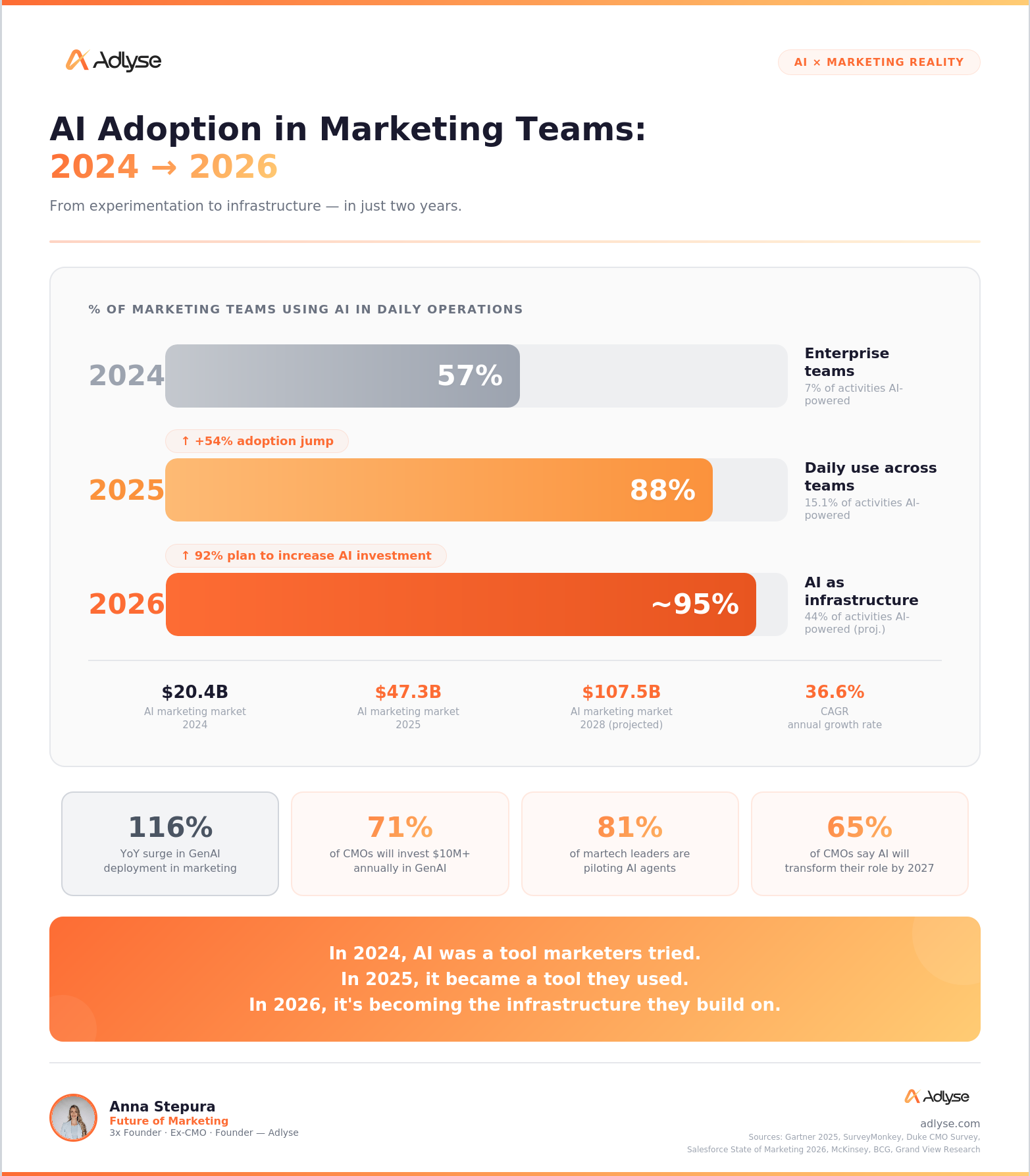
- 57% of marketing teams were using AI in daily operations in 2024
- 88% are expected to use AI daily in 2025
- ~95% will operate with AI embedded as infrastructure by 2026
- 92% plan to increase AI investment
- The AI marketing market is projected to grow from $20.4B (2024) to $107.5B by 2028
This isn't a trend.
It's a systems transformation.
The real question is no longer:
"Should we use AI?"
It's:
"Are we building our marketing around it?"
The Old Model: AI as a Productivity Tool
Most teams started with AI at the surface layer.
They used it to:
- Write ad copy faster
- Generate creative ideas
- Summarize reports
- Speed up research
Helpful? Yes.
Strategic advantage? Not really.
Because using AI as a task assistant doesn't change your marketing infrastructure.
It only accelerates manual processes.
The Core Problem
The Shift: AI as Marketing Infrastructure
The next phase of AI adoption isn't about speed.
It's about system-level intelligence.
When AI becomes infrastructure, it:
- Continuously analyzes campaign performance
- Identifies what's working, and why
- Flags inefficiencies in real time
- Connects performance data across platforms
- Replaces static reports with decision intelligence
This is where performance compounds.
Instead of hiring more analysts as complexity increases, teams deploy AI systems that monitor, optimize, and report automatically.
The result?
Scalable performance without proportional headcount growth.
Why This Matters for Growing Teams
For companies without a structured marketing department, this shift is even more critical.
As ad spend increases:
- Campaigns multiply
- Channels fragment
- Data becomes harder to interpret
- Reporting consumes more time
- Strategic decisions slow down
Without infrastructure, growth creates chaos.
With AI systems in place, growth creates leverage.
The Key Distinction
What AI-Powered Marketing Infrastructure Actually Looks Like
Infrastructure isn't a chatbot.
It's not a single automation.
It's a system built around continuous performance intelligence.
That includes:
1. Automated Business & Account Research
AI connects to your ad accounts, analyzes performance data, and understands your website and competitors automatically.
Instead of manually reviewing dashboards, the system builds a contextual profile of your business and campaigns.
2. AI-Driven Strategic Insights
Rather than just reporting metrics, AI identifies optimization opportunities:
- Which campaigns should scale
- Where budgets are inefficient
- What patterns are driving conversions
- Where performance is declining
This moves teams from reactive analysis to proactive optimization.
3. AI Assistant for Decision Support
Marketing leaders shouldn't have to dig through dashboards.
With an AI assistant, they can ask:
- "What drove conversions this month?"
- "Where is spend underperforming?"
- "Which campaigns have scaling potential?"
And receive immediate, structured analysis.
This replaces reporting time with decision time.
4. Contextual Memory & Continuous Learning
True infrastructure remembers.
It learns your business, campaign history, competitor positioning, and optimization patterns, improving recommendations over time.
That's how AI transitions from tool to strategic layer.
The Competitive Gap Is Widening
Over the next 24 months, two types of teams will emerge:
- Teams that use AI occasionally
- Teams that build AI into their performance architecture
The second group will:
- Make faster decisions
- Scale profitable campaigns earlier
- Reduce wasted ad spend
- Increase revenue per employee
- Handle more complexity without burnout
The gap between these groups won't be small.
It will be structural.
The Structural Divide
From Campaign Management to Performance Systems
Marketing used to be about campaigns.
Now it's about systems.
Campaigns are outputs.
Systems are engines.
When you build AI into your marketing stack:
- Optimization becomes continuous
- Reporting becomes automated
- Insights become instant
- Scaling becomes predictable
That's not automation for convenience.
That's automation for competitive advantage.
The Future of Marketing Is Systems, Not Services
The real opportunity isn't replacing marketers.
It's amplifying them.
AI-powered marketing systems allow teams to:
- Grow without linear hiring
- Improve ROAS without increasing effort
- Increase clarity across channels
- Shift focus from data gathering to strategy
This is where companies without structured marketing infrastructure can leapfrog competitors.
Not by hiring faster.
But by building smarter.
Final Thought: Are You Experimenting, or Architecting?
By 2026, AI won't be a feature in your marketing stack.
It will be the foundation.
The question is whether you're still experimenting with tools…
Or architecting systems.
At Adlyse, we're building AI marketing workers that analyze, optimize, and report across ad platforms, giving marketing teams clarity, control, and scalable performance without increasing headcount.
If you want to see how AI infrastructure changes your performance outcomes, explore how Adlyse identifies what's working, instantly.
"The future of marketing won't reward more effort. It will reward better systems."
Ready to Build Your Marketing Infrastructure?
See how Adlyse embeds AI into your performance system for smarter decisions at scale.