
If you are comparing Albert.ai alternatives, start with one question: do you want software that acts on its own inside guardrails and goals you preset, or software where every action traces to something a person approved, either a single change or a specific rule? Albert.ai describes itself as the first. Adlyse is built as the second. Neither is wrong. The right pick depends on how much control your clients, your finance team and your own team need to keep.
This post compares the two styles using what Albert.ai says on its own pages, and what Adlyse documents about itself. Vendor claims are labeled as theirs. We have not tested Albert.ai.
What does Albert.ai say it does?
Everything in this section comes from Albert.ai's FAQ and homepage. These are Albert.ai's claims, not ours.
- It works autonomously. The FAQ says: "After being configured and preset with guardrails and goals, Albert works autonomously." It also says Albert "takes action, making adjustments and improvements every moment of every day without delay."
- Humans set direction. The FAQ says clients are "responsible for setting the strategies and tactics for Albert to follow," and that Albert "does not define your strategy or develop your creatives."
- Budgets sit inside guardrails. Budget is managed "all within the guardrails you specify."
- Channels. The FAQ says Albert is integrated with Google's search and programmatic channels, plus Facebook, Instagram, YouTube and Bing. The homepage also shows TikTok and DV360 logos; the FAQ does not list them.
- Onboarding. The FAQ suggests a proof of concept, typically three months, and says you get a dedicated Customer Success team.
We did not find pricing on the pages we read.
What does Adlyse do differently?
Adlyse executes approved changes across six platforms: Google Ads, Meta, Microsoft Ads, TikTok, AppLovin and OpenAI's ChatGPT Ads. The differences that matter for this comparison:
- Every change traces to a human approval. A change runs after a person approves it, or automatically under a rule a person approved in advance, for example: pause any creative that has spent over $50 with no conversions. Rules then run without another click.
- Changes Adlyse proposes ship with a before/after preview and a stated hypothesis.
- Results are graded improved, hurt or neutral. A change graded hurt is reverted automatically.
- Guardrails are set first: budget caps, a spend ledger and a kill switch.
- Paid media only. Adlyse does not do SEO or GEO.
- Speed depends on the rule. A change waits for a person unless a rule they approved in advance covers it.
How do the two styles compare?
| Question | Autonomous (Albert.ai, per its pages) | Approval-based (Adlyse) |
|---|---|---|
| Who decides each change? | The platform, inside guardrails you preset | A person approves each change, or a rule in advance |
| Speed of action | "Without delay" | As fast as your approver, or immediate where an approved rule applies |
| What do humans own? | Strategy, tactics, creative, guardrails | Approval of each change or rule, plus the same inputs |
| Change record | Ask the vendor (see test below) | Hypothesis, approver, preview, verdict per change |
| Bad change | Ask the vendor | Graded hurt, then auto-reverted |
| Channels | Google, Facebook, Instagram, YouTube, Bing per FAQ | Google Ads, Meta, Microsoft Ads, TikTok, AppLovin and OpenAI's ChatGPT Ads |
| Onboarding | Suggested 3-month proof of concept | Ask Adlyse for terms that fit your accounts |
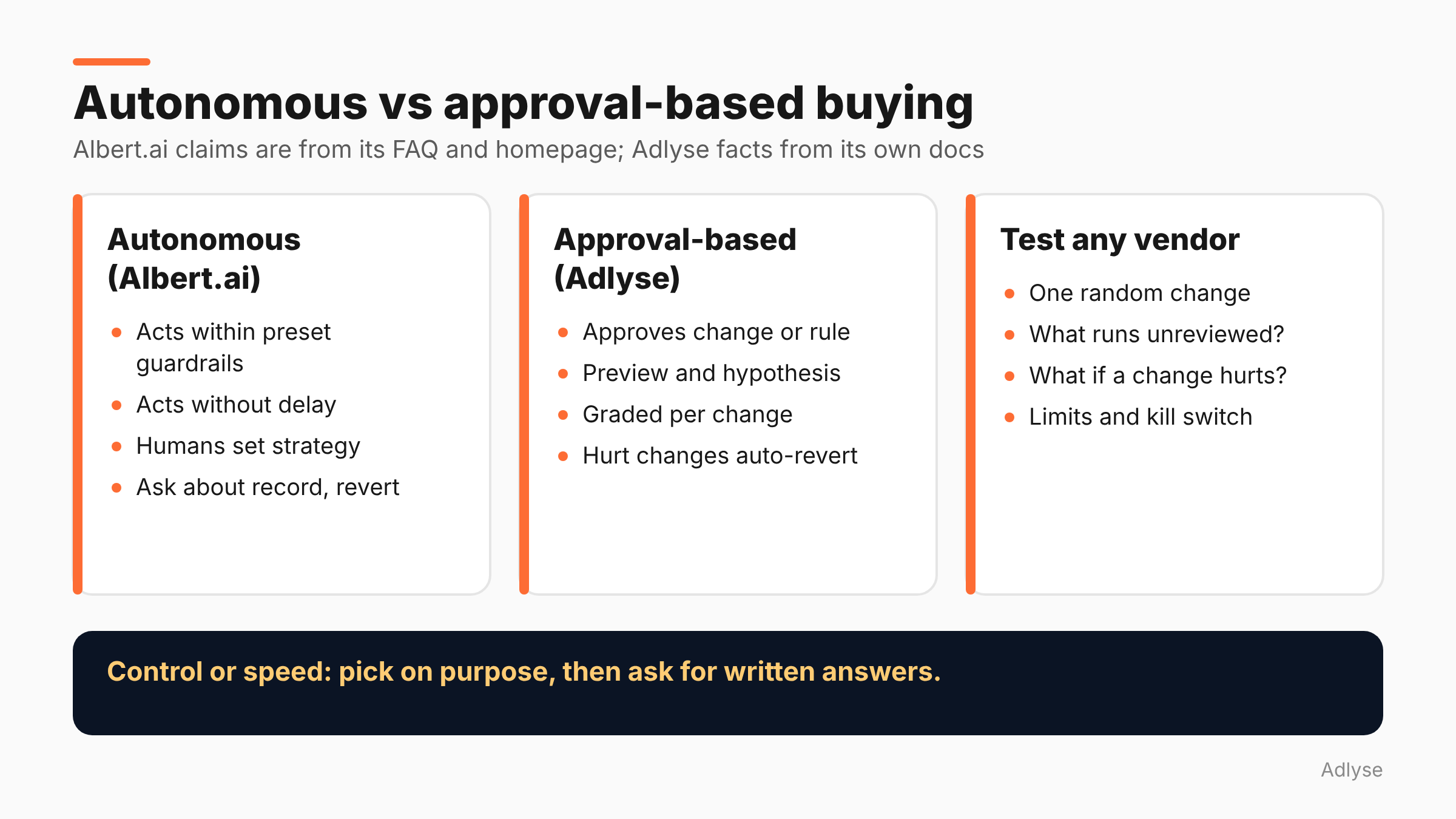
The gap is narrower than "autonomous or not." Both can act without a click on each change. The difference is what authorizes the action: guardrails and goals you preset (Albert.ai, per its FAQ) or specific changes and rules a person approved (Adlyse). Ask each vendor to show the authorization behind one automated action.
"Ask the vendor" does not mean Albert.ai lacks these. It means we found no statement on the pages we read. Ask.
When is an autonomous tool the better fit?
Pick the autonomous style when:
- You want the software to choose actions, not just apply your rules. Albert.ai says it acts within guardrails and goals you preset, and that clients set strategy and tactics.
- Your guardrails are tight and well understood. The tighter the budget, the lower the risk of letting software act.
- Your team does not want to write and review rules. Per-change approval creates a queue, and standing rules shift the work to writing and checking the rules.
- You want a managed service. Albert.ai says customer success is included.
Be honest about this. An approval gate is a trade: control in exchange for speed and staff time.
When is an approval-based tool the better fit?
Pick the approval style when:
- Clients or finance must sign off. If someone above you can ask "who approved that?", you need a name and a time on every change.
- You run several platforms. A review queue across Google, Meta and Microsoft is easier to audit than three autonomous systems.
- You want results graded. A verdict per change tells you which ideas worked, not just whether the account improved.
- You need a fast stop. A kill switch and automatic revert limit the cost of a bad call.
If your concern is trust more than speed, read AI Autonomy in Ad Spend: The Guardrails That Actually Matter.
How do you test any vendor before you sign?
Use the same five questions on every platform, including Adlyse. They match our evaluation guide for agentic AI marketing tools.
- Pick one change at random from last month. Ask for the full record: what changed, why, who allowed it, when.
- Ask what runs without a person. Get the list in writing, and who defined "low risk."
- Ask what happens when a change hurts. Revert automatically, alert, or nothing?
- Ask for the hard limits. Budget caps, pause or kill switch, and who can trigger them.
- Ask how results are judged. Account-level numbers, or each change against a stated prediction.
Run a proof of concept only after you have written answers. A three-month trial is a long time to learn something a one-hour call would have shown.
How does this compare with other alternatives?
Albert.ai is one of several names buyers compare. For a side-by-side with two others, see Synter alternatives, and for Adlyse against Albert.ai directly, see the Adlyse vs Albert page. Each vendor frames control differently, so use the five questions above rather than feature lists.
What are the limits of this comparison?
- We have not used Albert.ai. The Albert.ai column is built from its FAQ and homepage.
- Pages change. We read them in November 2026. Check them again.
- We are a vendor. Adlyse sells one of the two styles. Weigh our framing accordingly, and run the test yourself.
Ready to see Adlyse on your accounts?
Book a walkthrough and we run it against a live account, so you see the workflows, the approvals, and the reporting for yourself.
Request access