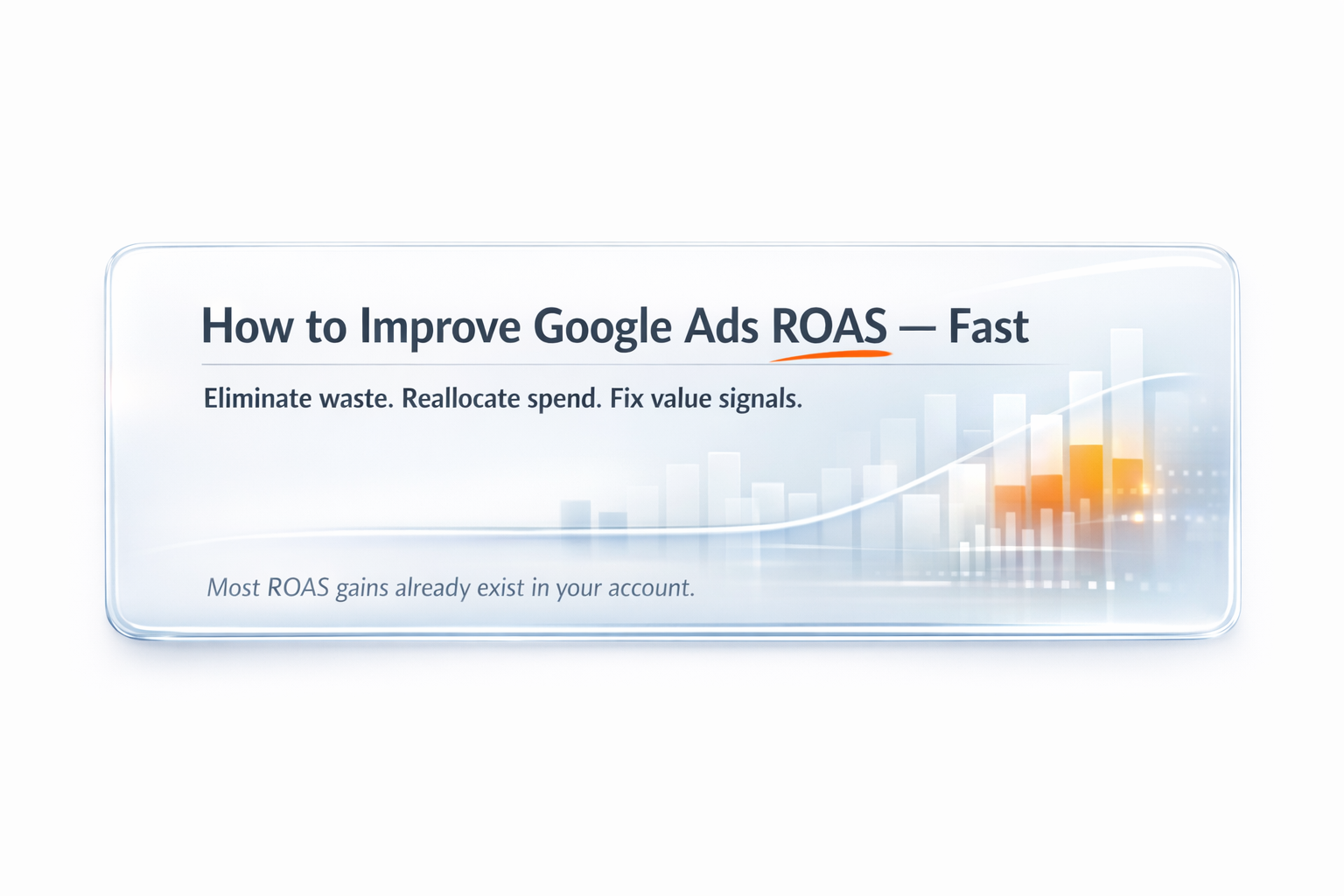
How to Improve Google Ads ROAS — Fast
Higher ROAS. 10x less work.
Put Adlyse on your accounts. Daily audits, agentic optimization, and reports your clients actually read.
Request a demoHow can I improve my Google Ads ROAS quickly?
You can improve your Google Ads ROAS quickly by eliminating wasted spend, reallocating budget to proven revenue drivers, and aligning bidding with accurate conversion value signals — all before launching new campaigns or increasing budget.
That's the short answer.
And for most accounts, it's also the fastest path to results.
In this article, we'll break down how to improve ROAS fast, why most teams miss these gains, and what data-backed actions actually move the needle — without scaling workload or headcount.
The context: why "quick ROAS wins" feel hard (but aren't)
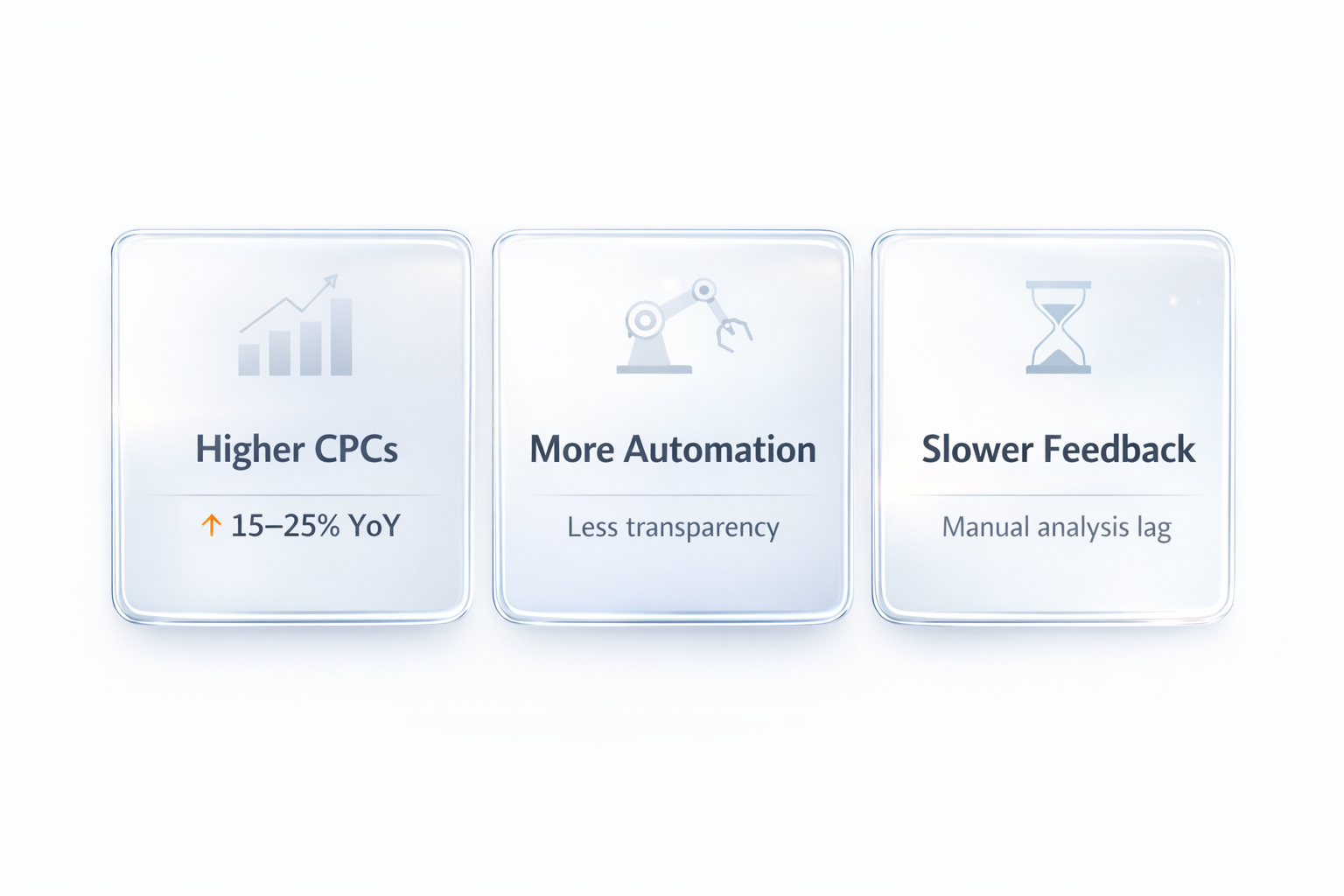
If you're running Google Ads today, you're operating in a tougher environment:
- Higher CPCs across most verticals
- More automation, less transparency
- Slower feedback loops from manual analysis
According to multiple industry benchmarks, advertisers have seen year-over-year CPC increases of 15–25% in competitive categories, while conversion rates have stayed flat or declined. That puts immediate pressure on ROAS.
The mistake most teams make?
They respond by testing more, adding campaigns, or tweaking bids — instead of fixing what's already broken.
The real problem: ROAS drops because waste hides in plain sight
ROAS rarely collapses because nothing works.
It drops because inefficient spend quietly grows faster than efficient spend.
Common symptoms:
- Campaigns are generating conversions — but little revenue
- Broad or automated campaigns consuming budget without intent
- Bidding optimized around incomplete or misleading conversion signals
"In most accounts, 20–40% of spend contributes little to revenue — and that's where fast ROAS gains live."
The 5-Step Framework for Fast ROAS Improvement
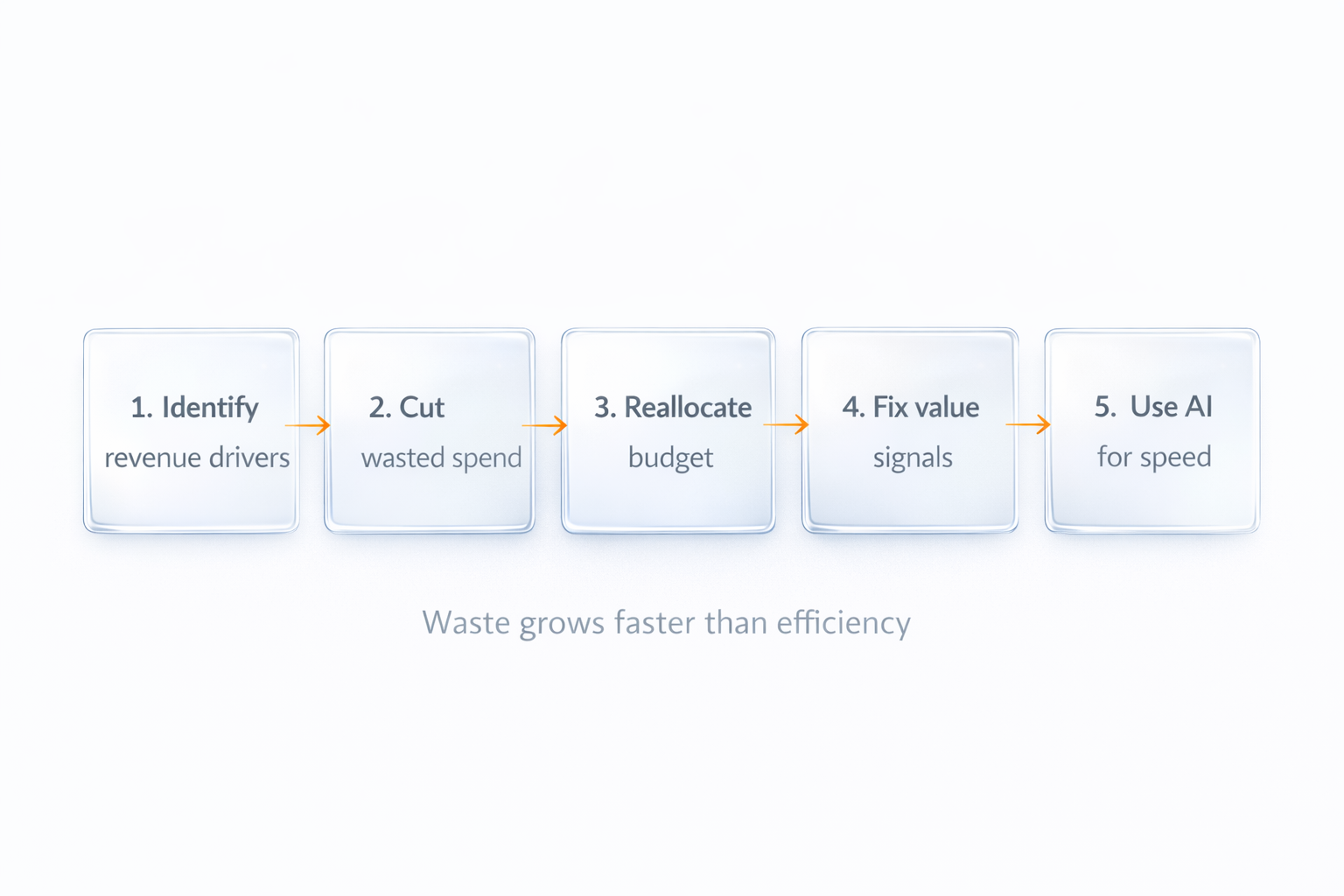
Step 1: Identify what's actually driving revenue (not clicks)
The fastest ROAS improvements come from separating performance from noise.
Instead of looking at blended ROAS, break performance down by:
- Campaign type (Search, Performance Max, Brand vs Non-brand)
- Search terms, not just keywords
- Match types and intent levels
- Conversion value distribution
Data from Google's own advertiser studies shows that a small subset of queries often drives the majority of conversion value — while long-tail queries absorb spend with diminishing returns.
Quick win: Pause, cap, or restructure campaigns that convert but don't materially contribute to revenue.
This is where automated analysis dramatically outperforms manual spreadsheets — it surfaces revenue drivers in minutes, not hours.
Step 2: Cut wasted spend before you "optimize" anything
Before adjusting bids or creatives, remove obvious inefficiencies.
High-impact ROAS leaks include:
- Broad match keywords pulling low-intent traffic
- Search terms misaligned with your actual offer
- Campaigns optimized for secondary or low-value conversions
Fast actions that improve ROAS almost immediately:
- Add negative keywords from high-spend / low-value queries
- Exclude poor-performing locations, devices, or time segments
- Remove "nice-to-have" conversions from bidding strategies
According to Google Ads best-practice research, cleaner conversion signals alone can improve automated bidding efficiency by 10–20% — without changing budget.
Step 3: Reallocate budget to proven performance signals
ROAS doesn't improve by spending more everywhere.
It improves by spending more where predictability already exists.
Shift budget toward:
- High-intent, high-value queries
- Products or services with consistent conversion value
- Campaigns with stable cost-to-revenue ratios
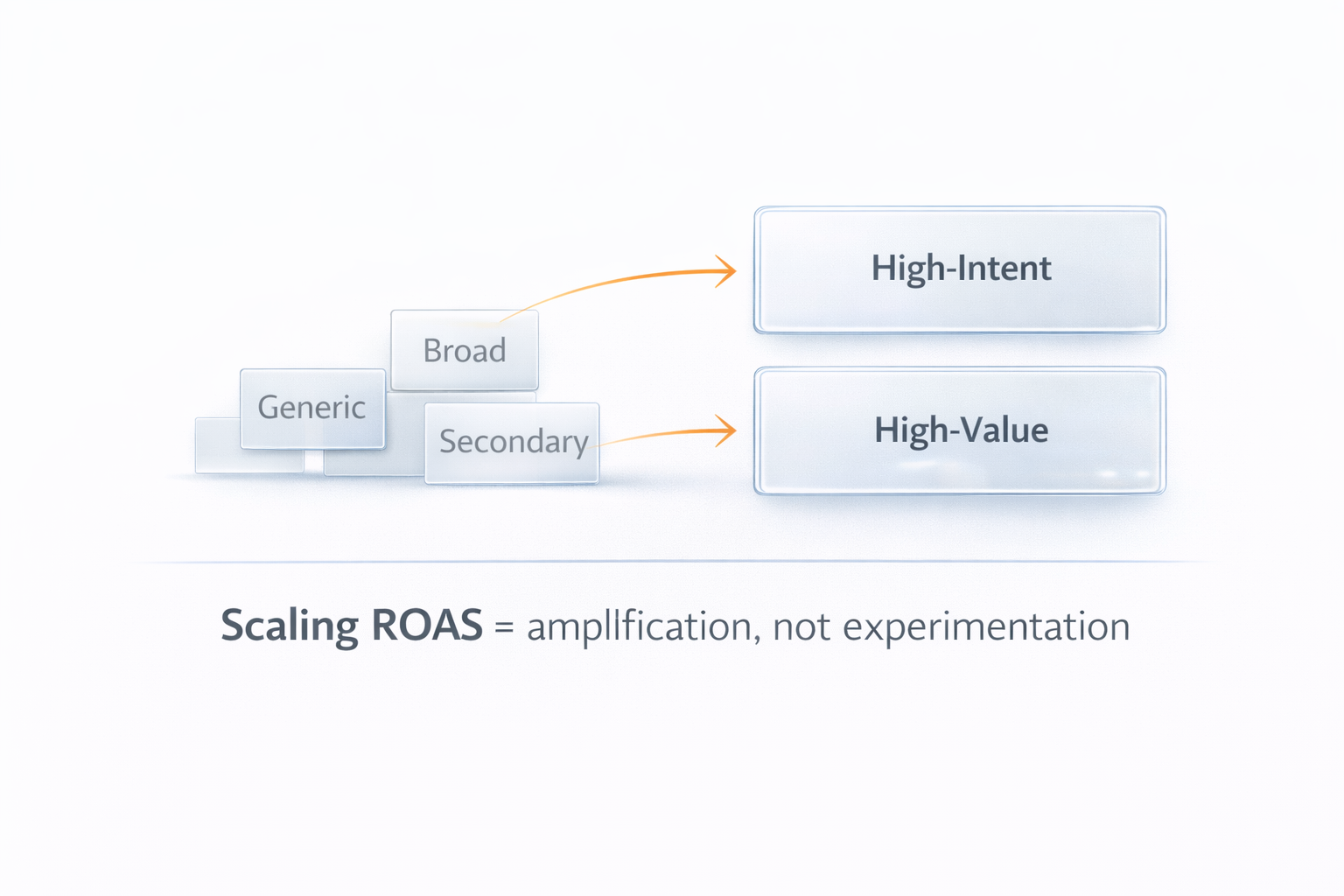
"Scaling ROAS = amplification, not experimentation."
Teams that reallocate instead of expanding often see short-term ROAS lifts within days — because they're feeding algorithms cleaner signals.
Step 4: Fix conversion value signals (the hidden ROAS killer)
Automated bidding can only optimize what it understands.
Common conversion value issues:
- Flat values applied to very different order sizes
- Leads treated equally despite huge quality differences
- Missing post-purchase or downstream revenue signals
Industry research consistently shows that advertisers using accurate, value-based bidding outperform those using binary conversion signals.
Fast improvement: Align conversion values with actual revenue impact — even if imperfect. Directional accuracy beats false precision.
Step 5: Stop guessing — let AI surface patterns instantly
Manual analysis slows down ROAS recovery.
Modern AI systems can:
- Detect performance patterns humans overlook
- Explain why ROAS changed — not just that it changed
- Prioritize actions by expected impact, not effort
This is why high-performing teams increasingly rely on AI-powered performance intelligence instead of reactive optimization cycles.
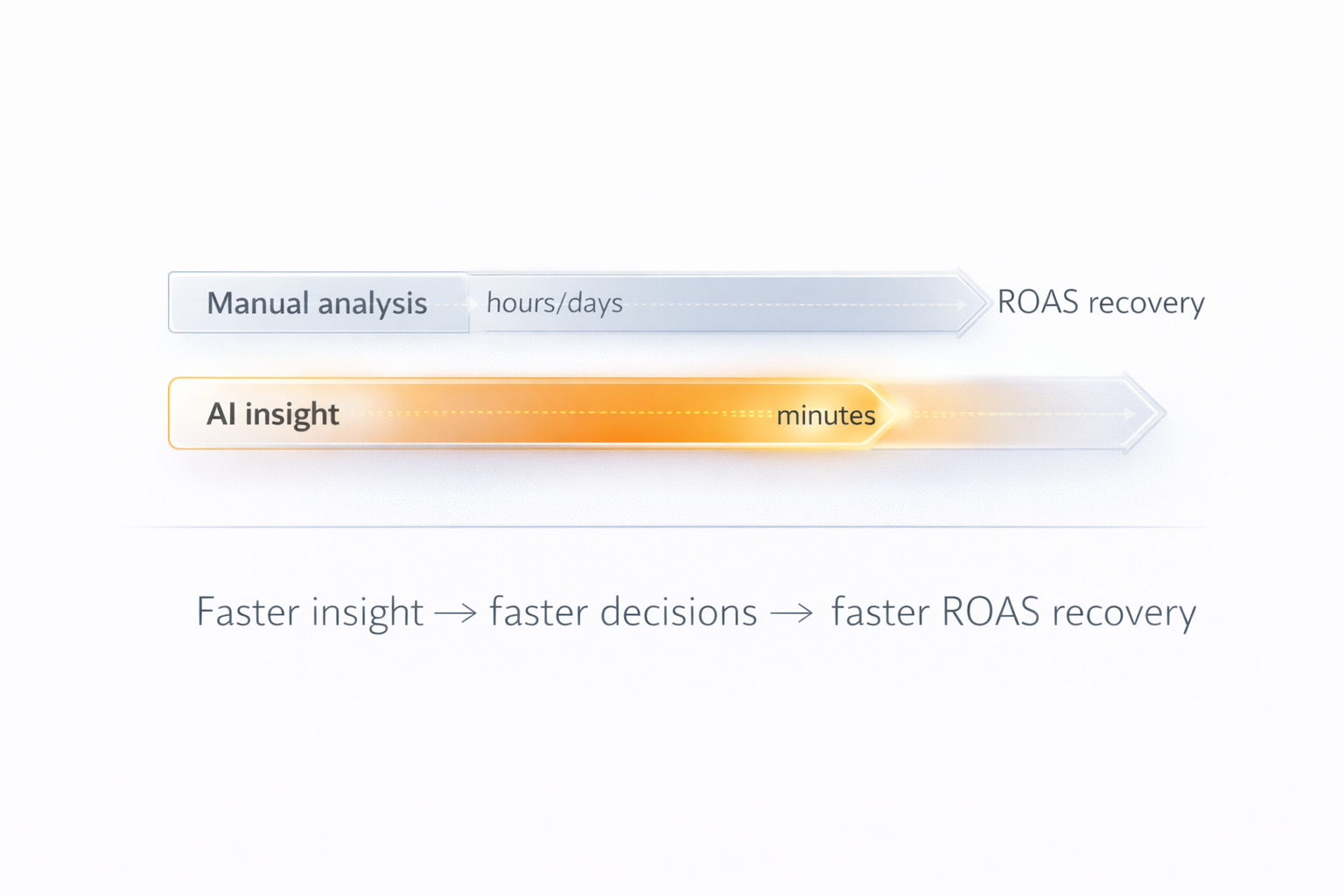
"Faster insight → faster decisions → faster ROAS recovery."
How Adlyse helps teams improve ROAS faster
Adlyse is built specifically for this problem.
It automatically:
- Analyzes your Google Ads account and website
- Identifies what's driving revenue vs. wasting spend
- Provides AI-powered recommendations on what to scale, pause, or fix
- Generates on-demand performance reports without manual work
Instead of spending hours diagnosing issues, teams get immediate clarity on what's holding ROAS back — and what will improve it fastest.
Final takeaway
If you're asking "How can I improve my Google Ads ROAS quickly?", the answer isn't more campaigns or more testing.
It's this:
- Eliminate waste first
- Reallocate spend to proven revenue drivers
- Fix conversion value signals
- Use AI to surface insights faster than manual analysis ever could
"Most ROAS gains already exist in your account — speed comes from clarity."
👉 See how Adlyse identifies what's working (and what's not) in your Google Ads account — instantly.
Get a real performance breakdown and uncover your fastest ROAS opportunities.