The Marketing Org Chart Is Being Rewritten: 5 Jobs AI Is Replacing, And 5 It's Creating
Higher ROAS. 10x less work.
Put Adlyse on your accounts. Daily audits, agentic optimization, and reports your clients actually read.
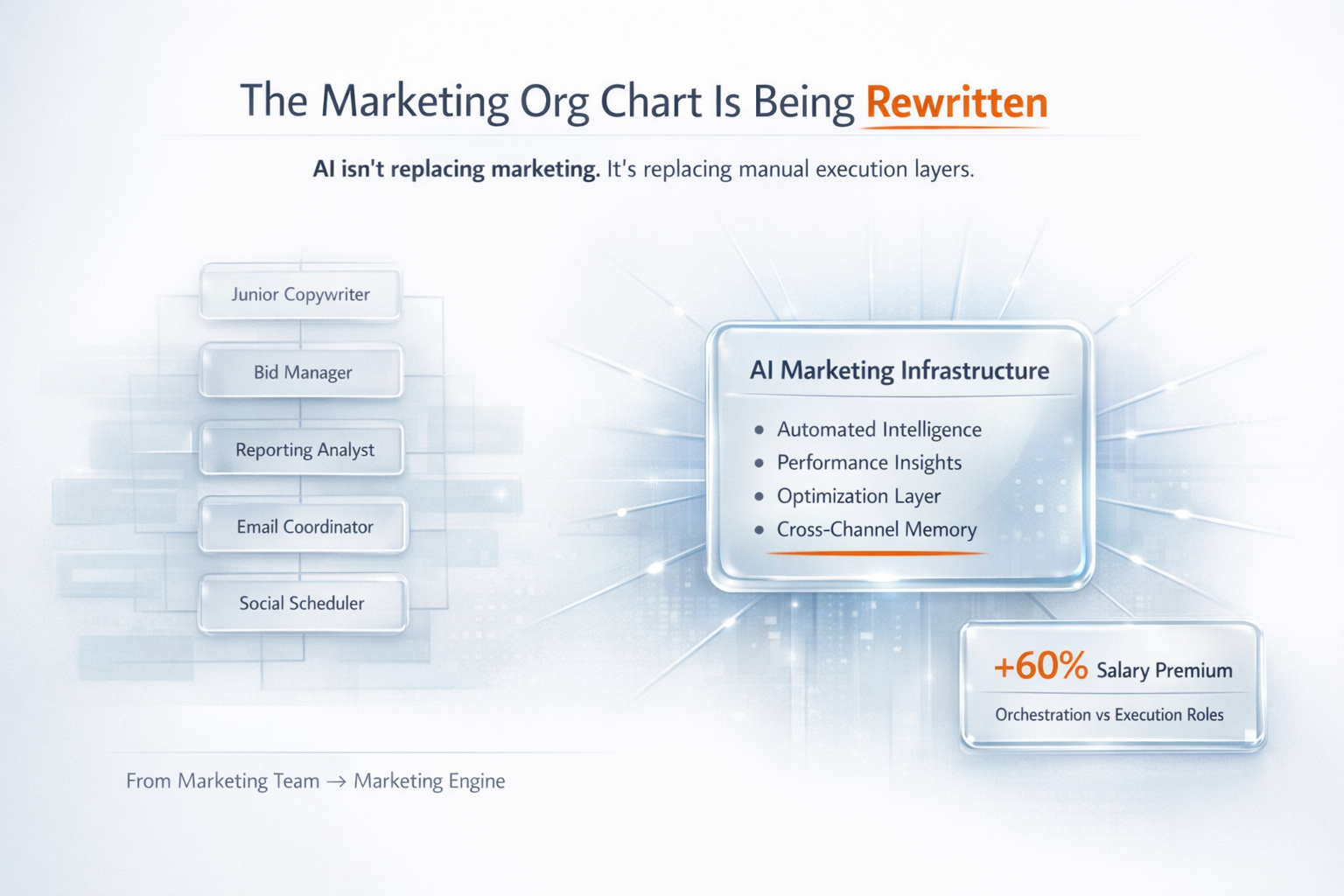
Request a demoAI isn't eliminating marketing.
It's eliminating manual execution layers.
According to global workforce projections, millions of roles will disappear, and millions more will be created. But in marketing specifically, the shift is more strategic than dramatic.
"Execution is being automated. Orchestration is becoming premium."
The question isn't whether AI will impact your team.
It's whether your marketing infrastructure is built for the shift.
The Old Model: Execution-Heavy Marketing Teams
For years, marketing departments scaled like this:
More channels → More campaigns → More hires.
Need more ads? Hire a copywriter.
Need better bidding? Hire a specialist.
Need reports? Hire an analyst.
Need lifecycle emails? Hire a coordinator.
This created bloated execution layers.
And today, those layers are exactly what AI systems automate.
Roles Being Replaced (Execution Layer)
- Junior Copywriters (variation production at scale)
- Manual Bid Managers
- Reporting Analysts exporting dashboards
- Social Media Schedulers
- Email Marketing Coordinators
The Common Thread
But here's what most people miss:
AI isn't removing marketing complexity.
It's shifting where value lives.
The New Model: AI-Orchestrated Marketing Infrastructure
As execution automates, new roles are emerging, and they're fundamentally different.
Roles Being Created (Orchestration Layer)
- AI Marketing Strategist
- Prompt Engineer
- Marketing Automation Architect
- AI Agent Operations Manager
- Customer Journey Architect
Notice the pattern?
These are system builders.
Not task executors.
The Compensation Gap
Orchestration roles: ~$109K–$173K
That's a 60%+ salary premium.
Why?
Because leverage has shifted.
The person who builds and manages AI systems now produces the output of 3–5 execution roles.
The Real Problem: Most Companies Don't Have Marketing Infrastructure
Here's where companies without structured marketing departments struggle.
They don't lack effort.
They lack systems.
Without AI-driven infrastructure, marketing looks like:
- Channel silos
- Fragmented reporting
- Delayed insights
- Reactive optimizations
- Rising CAC with unclear cause
Teams are busy.
But the system isn't intelligent.
And when performance declines, the response is usually:
"Hire someone."
But hiring into a broken system only increases cost, not clarity.
The Shift: From Marketing Team to Marketing System
The future marketing department is not built around headcount.
It's built around AI-powered workflows.
Modern marketing infrastructure should include:
1. Automated Business & Account Intelligence
When you connect ad accounts, your system should automatically understand:
- Your website
- Your positioning
- Your competitors
- Your historical performance patterns
Manual audits shouldn't be required.
2. AI-Powered Performance Insights
Not dashboards.
Insights.
You shouldn't just see clicks and conversions, you should know:
- What's working
- What's not
- Why performance is shifting
- What to scale
- What to pause
3. On-Demand Reporting & Querying
Instead of exporting reports manually, teams should be able to ask:
"How many clicks did we get this month?"
"Which campaign is driving the highest ROAS?"
"What changed week-over-week?"
And get instant, structured answers.
4. Optimization Layer
The system should suggest:
- Budget reallocations
- Campaign restructuring
- Creative direction signals
- Competitive positioning insights
Not just display data.
The Key Distinction
Why Execution-Only Marketing Will Lose
Companies that continue operating with:
- Manual reporting
- Platform-by-platform optimization
- Human-only bid adjustments
- Reactive decision-making
Will face three problems:
- Rising acquisition costs
- Slower iteration cycles
- Burnout within performance teams
Because their competitors will be operating on AI-accelerated feedback loops.
"Faster insights → Faster decisions → Faster scaling."
This is no longer optional.
It's structural.
AI Workers: The Missing Layer in Modern Marketing
The companies that win won't just "use AI tools."
They'll embed AI workers directly into their marketing stack.
An AI worker should:
- Analyze Google Ads, Meta, and performance data automatically
- Understand your business context
- Maintain memory across campaigns
- Generate reports instantly
- Provide optimization recommendations
- Reduce manual analysis time
The Goal
What This Means for Companies Without Structured Marketing Teams
If your company doesn't have a fully built-out marketing department, this shift is even more important.
Because AI infrastructure allows you to:
- Operate like a mid-sized performance team
- Make data-backed decisions without hiring multiple analysts
- Scale campaigns without scaling payroll
- Build predictability into paid performance
Instead of hiring five execution roles, you build one intelligent system.
That's leverage.
The Future of Marketing Is System-First
The companies that dominate in 2026 and beyond will share one trait:
They will treat marketing like infrastructure, not activity.
AI systems will handle execution.
Humans will handle direction and strategy.
And the organizations that implement AI-powered performance layers early will build:
- Faster optimization cycles
- Stronger ROAS stability
- Clear cross-channel intelligence
- Scalable growth without team expansion
The org chart is being rewritten.
The real question is:
"Are you still hiring into the past? Or are you building the system that replaces the need to?"
If you want to see how an AI marketing worker can analyze, optimize, and report across your campaigns automatically, explore how Adlyse identifies what's working instantly.
Because the future of marketing isn't more hands.
It's smarter systems.
Ready to Build Your Marketing Engine?
See how Adlyse turns your ad accounts into an intelligent, always-on performance system.