

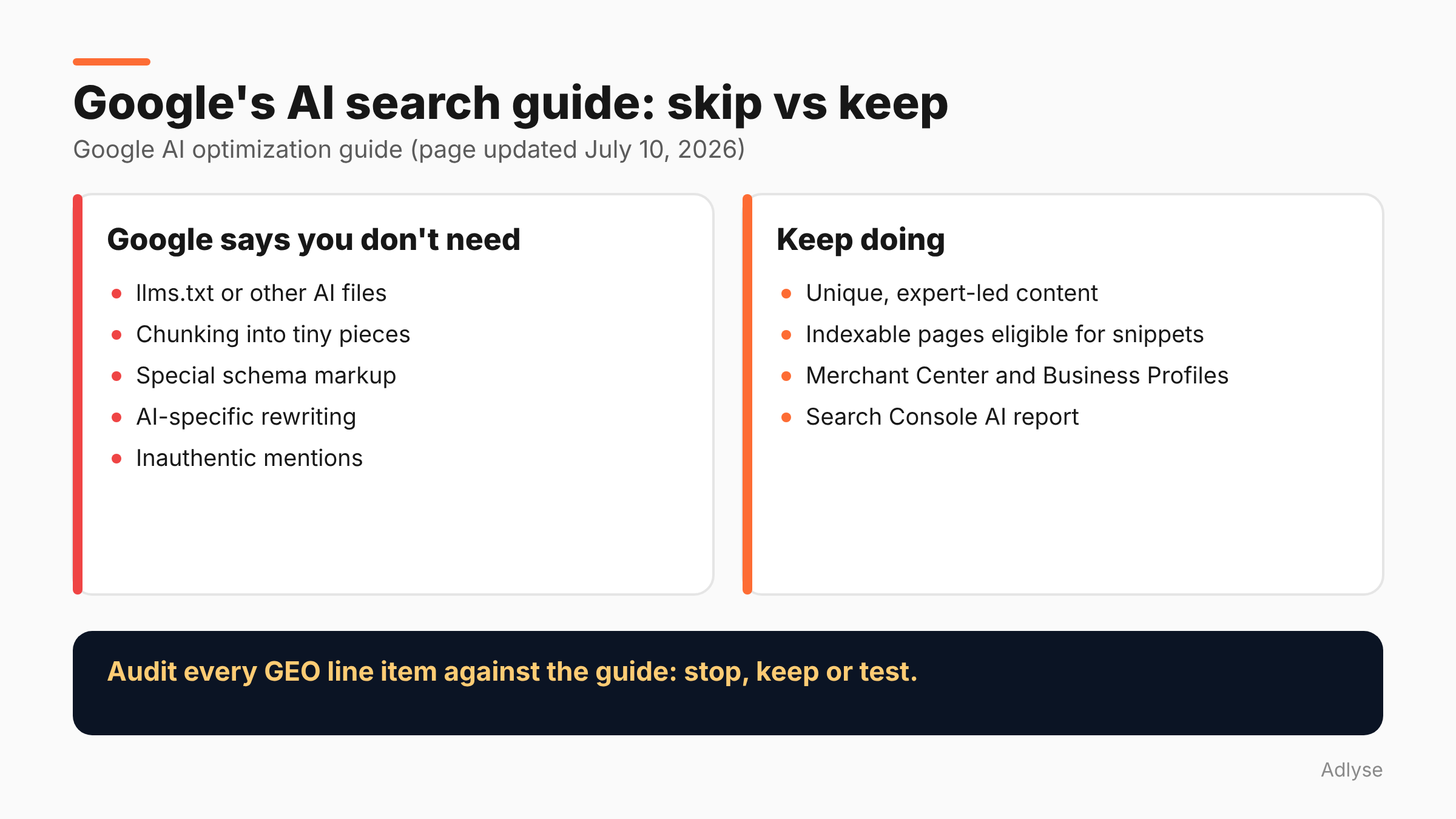
Google's own guide says you do not need llms.txt files, chunked content, special schema or AI-specific rewriting to appear in its AI search features. It also says seeking inauthentic "mentions" across the web "isn't as helpful as it might seem." If a vendor or agency is billing you for any of these, ask what they are for. This post is an audit you can run in an hour.
What does Google's guide say?
Google's AI optimization guide says its generative AI features, such as AI Overviews and AI Mode, rely on its core Search ranking and quality systems, so standard SEO best practice still applies. The page we opened was last updated on July 10, 2026. TechWyse reported that Google first published the guide on May 15, 2026.
The guide lists five things Google says you do not need to do, and what to do instead. The table below uses Google's wording where quoted.
| Myth | What Google says |
|---|---|
| Add llms.txt or "AI" files | "You don't need to create new machine readable files, AI text files, markup, or Markdown to appear in Google Search." Google says it doesn't use these files, so they neither help nor harm. |
| Chunk content into small pieces | "There's no requirement to break your content into tiny pieces for AI to better understand it." No ideal page length. |
| Add special schema | "Structured data isn't required for generative AI search, and there's no special schema.org markup you need to add." Structured data can still help with rich results. |
| Rewrite for AI | "You don't need to write in a specific way just for generative AI search." |
| Seek mentions across the web | Seeking inauthentic "mentions" "isn't as helpful as it might seem." |
What does Google tell you to do instead?
Per the page:
- Write unique, first-hand, expert-led content. Commodity content that repeats common knowledge adds little.
- Keep the technical basics sound. Pages must be indexed and eligible to appear with a snippet. Crawlability, JavaScript SEO, page experience and duplicate content still count.
- Use Merchant Center and Business Profiles so products and local businesses can appear in AI responses.
- Measure with the Generative AI performance report in Search Console. See our post on what that report can't tell you.
- Be careful with third-party AEO or GEO tools. The guide notes that none have access to Google's internal ranking or AI systems.
That last point deserves a second look if you pay for a tool.
How do you audit your own spend against the guide?
This section is our opinion. It turns the guide into a short exercise.
Step 1: List every GEO or AI-search line item. Include agency retainers, tool subscriptions and internal projects. Write what each is for.
Step 2: Match each one to the table above. If it is "create llms.txt files," "split every page into small sections for AI," "add AI schema" or "buy mentions," Google's guide says the thing is not required for Google's features.
Step 3: Separate Google from everyone else. The guide speaks to Google Search. It does not tell you what other AI tools do. If a tool targets another assistant, the test is different: does it have evidence for that assistant? Ask for it.
Step 4: Keep what also helps people. A clear page, a sourced claim and a working checkout are good for readers whether or not any AI reads them. Those cost little and need no new file.
Step 5: Ask for evidence, not adjectives. "It helps AI visibility" is not evidence. Ask for before-and-after data from a controlled test, or a stated cost of doing nothing.
Step 6: Decide. Stop, keep, or test for a fixed period.
Does this mean structured data is useless?
No, and the guide does not say that. It says no special markup is required for generative AI search. It still recommends structured data for rich result eligibility as part of overall SEO. If you use product markup to earn rich results, keep it. The point is not to add a new layer "for AI."
The same goes for a file like llms.txt. Google says it does not use these files, so they will not harm Search visibility either. If one already exists and costs nothing to maintain, there is no case for urgent removal. The case is against paying for it or expecting a result from it in Google.
What if the guide is wrong for your site?
It is a statement of how Google says its systems work. We cannot verify that from outside, and we have not seen a controlled test that proves or disproves each point. So treat it as the best available primary source, not as proof.
If you want to test a claim, do it narrowly. Pick one change, such as restructuring a set of pages, and keep a similar set unchanged for comparison. Our incrementality testing guide describes how to make that comparison fair. Do not run it during Black Friday week, when everything moves.
What about other AI tools?
The guide covers Google. For ChatGPT, Perplexity, Copilot and others, the primary sources are their own documents and publisher controls, and they change. Our guide to evaluating agentic AI marketing tools gives questions to ask any vendor who claims a result: what is the evidence, what is the test, and what does it cost to be wrong?
Where a new "standard" is proposed and a tool vendor sells it, ask who benefits and who reads it. A file nobody reads has no effect. That is a general rule, not a claim about any one standard.
What should agencies tell clients?
Three sentences are enough. "Google says AI search runs on the same systems as normal search. Google says you do not need special files or markup. We will focus on content, technical health and product data, and we will test anything else before we charge for it."
Then show a one-page audit: what you stopped, what you kept and why. Clients who read a lot of hype about GEO will often feel relief. Some will push back, because they have been told something different. Show the guide, then show your test plan.
What should you do next?
Run the six-step audit this week and put each line item in one of three boxes: stop, keep or test. If you run changes through Adlyse, each approved change ships with a hypothesis and is graded improved, hurt or neutral. A test of an "AI visibility" tactic should have one too.